pastpersistent

the past in pop culture

It’s a Downton, Downton, Downton World

Highclere

Highclere (Photo credit: neilalderney123)

What’s a Downton fan to do in the absence of the Abbey? Season three has ended and with it Sybil and Matthew, never to return. Oh yes, season four is in production but the only truly kind sister and the heir to the earl have signed off for good—unless of course Downton takes a turn towards the undead. If previously we suggested that Downton: Empire Edition might be a good idea, Downton: Vampire Edition sounds even better. Then the show could run for eternity and all that English pallor would be put to good use. At Donegal, most of the downstairs cast wouldn’t even need any new makeup or costuming.

But while awaiting these developments, we’ll need some interim entertainment. The obvious place to start is with an English aristocracy movie and TV marathon. Sure you’ve seen it all before, but it will fill up some of those empty hours. Go to Gosford Park, return to The Remains of the Day, slink on back to Brideshead Revisited. If your conscience doesn’t trouble you too much, take a tour of Upstairs, Downstairs. Some say Downton ripped it off and then resented its revival, but what’s another fox hunt or two between friends? After that, you’ll have to go a little farther afield. Bleak House beckons, and every Jane Austen movie ever.

You could try getting creative. Follow those plot leads and read Jane Eyre for another inconvenient married-man-with-a-mad-wife romantic complication. It must be Lady Edith’s bad luck to only get recycled love stories. Her earlier suitor, the disfigured amnesiac with a Canadian accent, sure did remind one of The English Patient, except of course for the fact that Ralph Fiennes didn’t whine about having a mummy’s head. Maybe it’s just that some Downton scriptwriter has a thing for movies with Juliet Binoche—Matthew’s last drive looked an awful lot like the final minute of The Unbearable Lightness of Being.

If that’s too far afield, find yourself some Downton fanfiction: with two thousand plus entries and counting, you’ll have plenty to read. Prefer professional writing? Never fear: the Fellowes’s are here. Jessica and Julian have helpfully penned The World of Downton Abbey and The Chronicles of Downton Abbey. Don’t think the actual inhabitants of Highclere are just renting it out for sets either. The Countess of Carnarvon would very much like you to read Lady Almina and the Real Downton Abbey: The Lost Legacy of Highclere Castle. In case your taste runs more to the downstairs, Margaret Powell’s Below Stairs: The Classic Kitchen Maid’s Memoir That Inspired “Upstairs, Downstairs” and “Downton Abbey” has been conveniently re-issued and re-titled.

For the less literal minded, Downton as metaphor might work. Downton’s depiction of a hierarchical social structure under pressure has inspired some reflections on contemporary Catholicism. On the secular side, it turns out that Downton confronts us with questions of free will and individual agency. It might seem a bit like shooting fish in a barrel to point out that Downton’s popularity can be pegged to current concerns about rising income inequality, but that doesn’t make it less true.

Too many words, not enough pictures? Let’s take a look at the lamps of Downton Abbey. We could consider the clothes as Downton struts the runway. But you don’t have to drop that many dimes to dress Downton with these outfits for under a hundred. Don’t forget our crafty friends at Etsy: handmade Downton, anyone? Once you’re all decked out, you might as well go on the road. There are all inclusive season three tours and DIY budget vacays. For those stuck stateside, a tour of the mansions of Newport might do as the next best thing. By the time you’re back, season four might be ready to roll. Finally, don’t forget to cook up some Downton dainties. They’ll come in handy in case you get the Downton d.t.’s.

A Valentine for Frederick Douglass

Daguerreotype of Frederick Douglass

Daguerreotype of Frederick Douglass (Photo credit: Wikipedia)

As of this writing, Frederick Douglass still does not appear in Steven Spielberg’s Lincoln. Spielberg has gotten a lot of grief for this, as has his screenwriter Tony Kushner who started with a script that included Douglass but then left him out. The black characters who did make it into the film are mostly kindly, grateful, and token. Sure, there’s one angry black man at the start who’s intent on holding Mr. Lincoln accountable, but he isn’t Frederick Douglass and the other black soldier who is with him keeps laughing at Lincoln’s jokes. Spielberg’s Lincoln is in good company at this year’s Oscars though—Argo and Zero Dark Thirty have also been raked over the historical accuracy coals for what they left in, left out, or just plain made up. And in far off Chile, film director Pablo Larrain recently invoked Spielberg in defense of his Oscar nominated movie No in which a complicated social movement that led to a national referendum to oust dictator Augusto Pinochet is told primarily as the story of a single man and his ad campaign. Worse, many of the people who were actually involved are very much among the living and not all have had kind words for the film.

Frederick Douglass, we hope, is resting in peace. And since he will not be on screen this year and nor will any actor portraying him be on the red carpet at the Oscars next week, let’s remember him on this his birthday. Douglass chose Valentine’s Day to celebrate the day of his birth because his mother, who he saw only a handful of times during his childhood in slavery, called him her “little valentine.” He didn’t know his own birth date because, as he writes in his autobiography, no slave ever did. Even as a child he wondered why he was deprived of this privilege. It’s fitting that Douglass’s chosen birthday falls between that of Lincoln and Washington. There is a considerable distance between the two on the question of slavery and Douglass as much as anyone and more than most helped to move the country in the right direction. If this isn’t in the movie, well, Hollywood history has always left a lot on the cutting room floor and Spielberg is not a documentarian. Douglass is not in Lincoln. So here’s a thought: how about next year a movie titled Douglass for Best Picture?

Carnival is Over and Other Sinking Feelings

English: Pieter II Brueghel (the Younger) (156...

English: Pieter II Brueghel (the Younger) (1564-1638). The Fight Between Carnival and Lent. Copy of a painting by Pieter I Brueghel (the Elder). Royal Museums of Fine Arts of Belgium, Brussels, Belgium. Detail (Photo credit: Wikipedia)

Yesterday’s Fat Tuesday is today’s Ash Wednesday and a time for sober reflection. It’s been a rough week for ancient traditions. A pope stepped down for the first time since 1294. In Venice, where carnival has been celebrated since even before that time, revelers had to wade through high waters and melting snow in the sinking city. In Brazil, a carnival float caught fire and killed four too soon after that country’s deadly nightclub fire earlier this month. And somewhere on the Gulf of Mexico, a ship by the name of Carnival Triumph continues to drift after an engine room fire left it without power. Its four thousand plus passengers now face conditions remarkably like those of eighteenth and nineteenth century steerage class. The stench and filth below has driven some to sleep in tents on deck. Passengers report scarce food, long lines, and bad behavior. There are fears of disease and worries about the health of the elderly and handicapped. It’s no doubt a blessing for the cruise company that the lack of power has left people largely unable to use their cellphones and other such devices: so far, most of these reports are not accompanied by pictures. With luck, the beleaguered travelers will be towed to port in Alabama by today. They can, at least, be thankful they didn’t meet the fate of the passengers of the Costa Concordia—another ship belonging to the Carnival company. After running it aground, the captain decided to get off before his passengers had been rescued. What’s next? Women and children last? Yes, that too. Not even on our beloved Titanic where the captain did indeed go down with his ship were the male passengers quite as self-sacrificing as they have often been portrayed. While women and children mostly survived from first and second class, in steerage the rates were reversed. At least on the Titanic the captain gave the order to save women and children first. In most maritime disasters, survival rates were highest for the crew, followed by the captains (!), then women, and children dead last. Turns out that the real rule has been every man for himself. It seems unlikely that the Carnival line will re-name itself Lent any time soon, but it’s a thought.

Happy Birthday Mr. Lincoln-Lewis

Abraham Lincoln

Abraham Lincoln (Photo credit: The U.S. National Archives)

Given that Daniel Day-Lewis is known to inhabit his roles deeply—even texting Sally Fields as Abe—one wonders whether he feels like today is his birthday, too. It would be a well-deserved celebration. His Lincoln seems a daguerreotype come so to life that it is uncanny. Nor is this all. In Lincoln there are ghosts of other films and shades of other performances. With Daniel Day-Lewis as the lead these haunt the imagination. He has inhabited other roles and been especially at home in movies about the past.

Given the Civil War setting, his Bill the Butcher in Gangs of New York most immediately comes to mind. Bill was no Lincoln fan and the scene in which he throws a knife at a Lincoln poster seems mostly funny in retrospect. More striking is the other Lincoln in Gangs: the costumed actor from the cast of Uncle Tom’s Cabin who is suspended above the stage and directs the actions of the characters. As he proclaims, “And Topsy, dear little Topsy, cradle Uncle Tom’s head,” the Lincoln performer nervously eyes the audience. And with good reason—the play doesn’t so much end as erupt when the very tough crowd starts pelting the stage with rotten fruit. This, truly, is a performance of Lincoln in extremis. It’s this other Lincoln, this vaudeville hack who points to the greatness of Day-Lewis’s performances. The rendition of Uncle Tom’s Cabin in Gangs is supposed to be bad theater and audiences of the time generally were that rowdy. But it’s the faux-Lincoln’s declamation that steals the scene because it’s so marvelously bad. Sometimes it takes a dose of bad acting to set the real thing in relief.

In Gangs, one such moment comes when Bill rejects the notion that the Irish immigrants can become a part of America. He doffs his stovepipe hat—tall as Lincoln’s, but a good bit filthier—to reveal the greasiest case of hat head imaginable and explains that his father gave his life for this country, “murdered by the British with all of his men on the twenty-fifth of July, anno domini, 1814.” In another echo, and another reversal, a father murdered by the British also steps out of the past from Day-Lewis’s early role as Gerry Conlon in In the Name of the Father. Day-Lewis, as Conlon, must come to terms with his relationship to his father who is unjustly convicted for a role in an IRA bombing and dies while both are in a British prison. In Gangs, Leo DiCaprio seeks to understand his Irish father’s death at Bill’s hand. Got that? Day Lewis has played a Lincoln hater and Lincoln, an Irish victim and an Irish persecutor. Yet the role of the father, and of the son, resonates across each of these films. It’s Day-Lewis’s portrayal of Lincoln as a father who has lost one son, and who refuses to lose another, that makes the man real. That the father is then martyred makes it transcendent. Hats off to Lincoln-Lewis.

Royal Reliquaries, or Who Do You Think You Are?

Richard III Royal Collection

Richard III Royal Collection (Photo credit: Wikipedia)

Richard III’s bones were found under a car park, Henri IV’s head was kept in a jar, Louis XVI’s blood was soaked into a decorative gourd. All of these remains were recently proved real by DNA testing and publicized with splashy press releases. Each had met a violent end: Richard hit over the head on Bosworth Field by a pretender to the throne, Henri stabbed to death by a religious fanatic, Louis guillotined by revolutionaries. None of those stories were ever in doubt yet the positive identification of these relics has made international news. One wonders why. Ghoulish fascination? Henri’s head was, after all, mummified. Perhaps it’s related to the rise of the royals as pop culture icons. Even more than her wedding, Lady Di’s funeral brought the world to a standstill. It might be all those forensic science shows. What’s been called the “CSI effect”—or our television induced belief that we know our way around a crime scene—has proved strong enough that it’s changing not only the behavior of jurors (who now expect evidence to be DNA tested) but also that of criminals (who have learned how to destroy crime scene DNA traces). A mixed blessing to say the least.

Our relationship with DNA testing is fraught. The CSI effect has also tended to make people believe in the infallibility of the process when, in reality, genetic matches are based on probabilities and not certainties. Belief, in other words, hinges on faith even now. Reliquaries always relied on magical thinking for their power. The image on the Shroud of Turin can be proved a fake over and over and yet its power persists: the image is miraculous. With bodily relics, the science and the magic come together. Royalty, after all, can only be maintained by a belief in bloodlines. In a world where royals exist outside of real political power, we can trade skepticism for escapism with little harm.

Yet if forensic science can ratify the fame of the named, it can do the same for the nameless. While the power of DNA evidence in popular culture feeds our fairytale fantasies, it also fuels our desire for justice. It goes far beyond the wrongly convicted who are freed by the analysis of a decades old crime scene sample or the coldest of cold cases that finally comes to a conclusion. Ordinary people have bloodlines, too. Ancestry.com has made a fortune off of this insight and its ingenious infomercial series, Who Do You Think You Are?, managed to sprinkle star dust on genealogical research. Ancestry, of course, is record and not DNA-driven, but when African Americans Blair Underwood and Emmitt Smith guest starred on the show their ancestral searches took inevitable turns toward genetic science. For some people, the paper trails stop cold. After the Middle Passage, the enslaved lost their connections to their homelands and only the rise of DNA databases has been able to bridge that gap. Smith located part of his ancestry in Benin, while Underwood got to meet a (very) distant cousin in Cameroon who seemed a little confused by the premise of the show but threw a party anyway.

These DNA matches aren’t perfect. But they’re also close enough to the truth that no one can deny what they reveal. Witness the recent announcements about Michelle Obama’s mixed race ancestry and the discomfort it has caused for what it says about the American past. DNA-based revelations about Thomas Jefferson and his slave Sally Hemings certainly helped lead to the recent statement by a well-known scholar that Jefferson was “one of the most deeply creepy people in American history.” Skeletons just don’t stay in the closet anymore. Even now archaeologists are exhuming the bodies of the mistreated and forgotten at a Florida reform school. In Pennsylvania, at a site called Duffy’s Cut, a team of dedicated historians, students, and scientists have dug up the remains of Irish railroad workers believed to have died of cholera in 1832 and revealed that they were murder victims. One was identified as John Ruddy in part by an abnormality in his teeth that matched that of living descendants. They hope to repatriate the body to Ireland. If so, Ruddy will be like Richard. Both king and commoner can rest in peace at last.

Three and a Half Weddings and a Funeral

British Female Munitions Worker

British Female Munitions Worker (Photo credit: Woodrow Wilson Presidential Library Archives)

The leading ladies of Downton have almost caught up with Hugh Grant and Andie MacDowell. Sybil, Mary, and Anna (yes, she’s a shadow sister) are all married. Edith got halfway married. And now Sybil is buried. So that makes three and a half plus one. One wonders of course whether the other half will be the forthcoming happy ending of season three, but since there’s only a little over a week to wait we can be patient. For the moment, Lady Edith remains unmarried and on the verge of turning into a career girl. For once, the historical reference for this plot line is both subtle and resonant. If Ernest Hemingway’s lost generation was mostly men, the other half of the sun that also rises was the generation of women who came of age with them. Back in Lady E’s day, poet and novelist Vera Brittain helpfully coined the term “superfluous woman” for all the single ladies left unwed by the war. Just a few years ago, Virginia Nicholson wrote a book titled Singled Out: How Two Million Women Survived without Men after the First World War. If Edith represents the high end of the trend—an educated woman of means who becomes (just guessing here) a crusading journalist—then kitchen maids Daisy and Ivy (btw: what’s up with the plant names?) represent the low—service workers who scrabble over the footmen. It’s a pity the scriptwriters didn’t think to come up with the third option: emigration. If we usually think of first world men importing third world women as picture brides, apparently British women were encouraged to take advantage of their vast imperial holdings and set out for India to husband hunt. Hmmm…a Downton Abbey: Empire Edition has real possibilities.

For now though, Edith remains tethered to the island. Her travails might be historically accurate but they are also notably of the moment. It’s been hard not to notice the full slate of “sex-marriage-mommy” magazine pieces that have made a big splash in the past year or two. If the lack of intellectual coherence in the genre that ranges from “Marry Him!” to “The End of Men” has made Pamela Erens in the L.A. Review of Books ask whether The Atlantic is making us stupid, its salience reminds us why Downton has done so well. As a group, its ladies and their domestics confront the modern girl’s every trial, tragedy and tribulation. As this post’s title suggests, most of these are by now resolved. Only Lady E’s fate remains to be seen. If one suspects—due to relentless conditioning over three seasons—that it will be a happy one, a word of caution. While Erens main point is that the recent high profile writings on the state of modern womanhood lack a crucial historical sense of feminism, one of the kickers in the piece is the news on how outnumbered women writers are at serious magazines and journals. So let’s cheer on Edith and her newspaper column. The world could use another woman writing.

Richard loves Richard; that is, I am I

Richard III, Act 5, scene 3: Richard, played b...

Richard III, Act 5, scene 3: Richard, played by David Garrick, awakens after a nightmare visit by the ghosts of his victims. (Photo credit: Wikipedia)

Richard III, it turns out, may have been not only a halfway decent guy, but probably hot to boot. That’s quite a turnabout for a man formerly known as a villainous child murderer whose twisted back mirrored his twisted soul. This particular reversal of fortune took more than five hundred years but it has set the twitter sphere a flutter. Since archaeological discoveries don’t usually make front page news, the University of Leicester clearly has learned the art of the reveal. The press conference managed to be interesting enough that several academics felt the need to weigh in and point out that none of this really changed history. Be that as it may, it sure was fun to see the mock-up of his head. Archaeologists have turned up stories more gruesome and bizarre than this one but even the mass grave of headless Vikings and the murder victims of the bog people lack that certain je ne sais quoi. Richard III’s got it. He’s played a cunning game—his biggest fangirl insists that Richard wanted to be found. Just in time, too: his genetic descendants apparently don’t have children and a few years hence their DNA wouldn’t have been around to identify him. That’s the thing. Those dead Vikings? The bog people? They didn’t have names. The gossip columnists didn’t pick up the poison pens for their stories. Lawrence Olivier, David Carradine, and Ian McKellen never played them. Were Richard around now, the Murdochs would have hacked his phone. The paparazzi would have tailed him through the Chunnel. He isn’t just a dead guy found in a ditch. He’s a dead guy with a fan club. Shakespeare might have done him wrong, but he knew Richard’s story had legs:

Death makes no conquest of this conqueror;
For now he lives in fame, though not in life.

Quoth the Raven

Library of Congress Prints and Photographs Division

Library of Congress Prints and Photographs Division

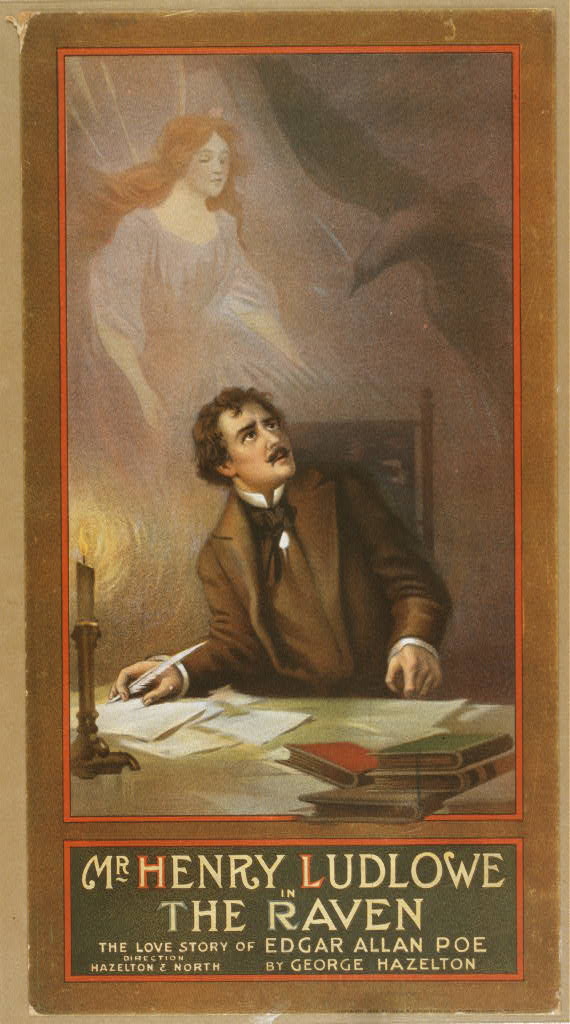
We seem to be having a Poe-ment. Between the premiere of The Following and the Ravens in the Superbowl, it looks like Edgar Allan is making a comeback. Poe could use a little love. He’s the patron saint of the down and out after all and Baltimore certainly qualifies on this count. They’ve had to fight for their Poe legacy. A couple of years ago an English professor threatened to mount a grave robbing expedition to retrieve Poe’s body. No, it wasn’t Joe Carroll, the fictional prof turned serial killer who gives Kevin Bacon’s telltale heart a run for the money, but a real life scholar from Philadelphia. After all, Poe spent a lot more time in Philly then Baltimore. Although it’s not known whether he wrote “The Raven” in Philadelphia or New York, he composed most of his major works in the city of brotherly love. (But hey, Philadelphia named its team after a different bird.) Baltimore has the distinction of being the city where Poe dropped dead after being found wandering the streets in a delirium. For their part, the citizens of Bodymore—a nickname that combines the best of Poe and the worst of The Wireplan on turning out in force should anyone try to bodysnatch their mascot. (Actually, the team has three: Edgar, Allan, and Poe.) It will be a historic contest this evening, pitting one bay city against another, east coast against west, poets versus gold diggers. Poe wrote a poem titled “Eldorado”

But he grew old–
This knight so bold–
And o’er his heart a shadow
Fell as he found
No spot of ground
That looked like Eldorado.

He finished it the spring of the gold rush year, but Poe never made it to Eldorado. In early October of ’49, he died and was buried in Baltimore.

1890s Redux: Portlandia, Steampunk and All Things Gilded

Elbert Hubbard

Elbert Hubbard (Photo credit: Wikipedia)

What’s up with the new 1890s? Portlandia nailed it with the “Dream of the 1890s” sketch last year. Except the ‘90s are not just alive and well in Portland, but also Brooklyn and a hundred hipster enclaves in between. Keeping chickens in the backyard and wearing Bible beards has even bled into the ‘burbs, surely suggesting that their cool factor is approaching its sell by date. And in related news, trendwatchers tell us that steampunk—the late 19th century inspired mashup of retro, sci fi, and post-apocalyptic style—is about to go big. By big they mean mainstream: forget Etsy, try Target.

Pickling, knitting, cheese making, and beer brewing can all be explained as a search for authenticity. But alienation is not exactly new. “It’s a long way back and this modern world has gone off the track. But you can escape it all in Portland.” The clue here is when Carrie Brownstein shimmies into the “Dream of the 1890s” as a flapper and gets re-styled. This ain’t the 1920s. That was so 2006: remember, before the bubble burst? The 1890s were a little darker. The Homestead Strike, Coxey’s War, the Panic of 1893, the Pullman Strike, the McKinley assassination, the start of the first overseas counterinsurgency in the Philippines. And let’s not forget the one percent. It’s not for nothing that economists and political scientists keep reminding us that it really is the Gilded Age all over again. Corporations have their human rights back; the plutocracy is eclipsing the meritocracy.

It’s all very Elbert Hubbard. Who? The original 1890s rebel, that’s who. Hubbard was a boy from the country who became a traveling salesman and then a corporate wunderkind (Hubbard innovated direct mail advertising). But the stresses and strains of the Gilded Age troubled him and he sold out his shares of the Larkin Soap Company to set himself up as a writer. After that, he did the coolest thing ever by today’s standards: he went to and then dropped out of Harvard.  He finally found his way when he started a utopian craft community, the Roycroft. Hubbard affected a personal style that stood out in his day, with long flowing hair and a hat from an earlier decade. He wrote that, “to wear a hat just like everybody else is to acknowledge that your head thinks the same thoughts that all other heads think. To wear a hat long out of fashion…is to throw down the gauntlet to the bourgeoisie.” And so Hubbard and his followers wore their outdated fashions and lived as artisans making fine furniture and hand-printed books.

The funny thing is that Hubbard never did stop wanting to make it big. He’d been inspired by William Morris’s uncompromising principles about handcrafted quality, but made sure to sell his Roycroft products at accessible price points by cutting corners where necessary. He endlessly promoted himself as an outsider even as he went on tour as a lecturer for increasingly large fees. And if he skewered the pretensions of the cultural elites in his ‘zines (that is, self-published chapbooks and literary journals), as his career went on, he wrote ever more admiring hagiographies of the one percenters of his day. In 1912, he wrote the original paean to the wealthy men of the Titanic who gave their lives so that women and children might live. Some of that text turned out to be eerily prescient, as he and his wife would go down on the Lusitania in 1915. It is often said that the sinking of the Titanic marked the end of the Gilded Age, but maybe the dream of the 1890s ended with the death of conflicted hipster huckster Hubbard on that other boat, the one sunk not by an iceberg but by an explosion.

Hyde Park on Hudson: All the President’s Women

Sara Roosevelt and her son, President Franklin...

Sara Roosevelt and her son, President Franklin D. Roosevelt, in 1933 at the family estate in Hyde Park, New York (Photo credit: Wikipedia)

What is it with the great liberal presidents and their women? It’s not that FDR’s cheating ways were a secret. His affair with his secretary Lucy Mercer was a key catalyst for Eleanor’s rise to greatness as a first lady who transcended both the office and her presidential spouse. Certainly there are shades of the Clintons here. But FDR’s first big affair is not the central story of Hyde Park on Hudson. Instead, we’re introduced to the story—fictionalized here, but apparently plausible based on the evidence—of his seduction of his distant cousin Daisy. She, not unlike the innocent viewer, stumbles into a romance that can only be understood as such by someone who is entirely naïve about the ways of the world. Since the romance isn’t a romance but rather an instance of a charming but old man putting the moves on a much younger woman who’s not really in a position to resist. There’s one kind of movie in that story line, but enfolding it into another movie that’s full of the kind of misty-eyed nostalgia that Americans have for the Great Depression and World War II era makes for an odd mix. The movie tries to resolve these two stories by suggesting that we must understand how hard it was for FDR to take care of everyone. Democracy, after all, is not the same as monarchy which is why FDR gets to play father figure to the poor old King of England who stutters and lets himself be henpecked. In the end, FDR must bear the burden of keeping up not just the spirits of the Americans as they slog through the Depression, but of the entire free world as the Nazi threat draws nigh. In Hyde Park on Hudson, the re-creation of FDR doing his jaunty cigarette-holder smile photo makes it clear just how hard that magic act was on the worn down and physically incapacitated president.

And so the women fall for it. Recently in The Atlantic, Caitlin Flanagan wrote about her ongoing romance with JFK. Like any good co-dependent girlfriend, she describes herself as constantly backsliding. She swears him off, calls herself a fool, and then it happens: she looks at the pictures of Kennedy with little John John and Caroline again. And in a flash the player-in-chief disappears. Even after reading the most recent Kennedy mistress tell-all, in which it becomes clear that very little was sacred to the President, Flanagan falls for him again. “Let him have the girls, I thought; he could handle the girls and still put in an ace performance as Father of the Century.”

What does showing FDR’s creepy old man side do for a very different, if no less beloved, icon of the twentieth-century? In the key scene of HPoH, when he puts his country cousin Daisy’s hand on his knee, we are directed to focus on the age spots and wrinkles of that hand. FDR is not just the national father figure, he’s the national grandfather except, of course, for the rather notable absence of any children in the movie. They’re substituted by the adults, who sometimes act like children and play strange little games with each other. The women seem caught in a particularly sad situation. The best thing anyone finds to say about Eleanor is that she’s “realistic;” Mrs. Roosevelt (FDR’s mother) is in denial even as she plays the procuress; the queen is anxious and hopelessly uptight; the secretary is fated to die; and Daisy herself realizes that her choices boil down to servicing the president or getting on her knees to help her aging mother put her stockings on. And so it’s odd that the film ends happily. England is saved, the King eats his hot dog (and likes it!), and the harem plays bridge together. Only poor old FDR is left isolated and debilitated, his heroic service to the nation soon to be rewarded with a deadly stroke.  There may be some psychological truth to this but it leaves one wishing for the rather different presidential woman that Laura Linney played so memorably in another role. Abigail Adams would have set Daisy straight.