pastpersistent

the past in pop culture

Category: Movies

Titanica: A Night to Remember, and Remember, and Remember

The iceberg suspected of sinking the RMS Titan...

The iceberg suspected of sinking the RMS Titanic; a smudge of red paint much like the Titanic’s stripe was seen near the base. (Photo credit: Wikipedia)

In 2016, the Titanic sails again. At least that’s the plan. Australian billionaire Clive Palmer recently signed a deal with a shipyard in Nanjing, China to begin construction on the recreation of the ill-fated ship that sank one hundred and one years ago. Right now Palmer is on the road with the Titanic II World Tour. Guests of the events enjoy an eleven course meal based on the menu served aboard ship on its last night and then they can tour Titanic the Exhibition. Palmer’s company, The Blue Star Line, is taking reservations for passage on the ship’s maiden voyage. The list is reportedly more than 40,000 names long already.

Rebuilding the lost liner raises some interesting questions. The re-built ship will feature the same exterior design and interior décor. Passengers will eat the same meals, be encouraged to dress in period costume, and even be obliged to respect the same divisions amongst first, second, and third class as on the original. On the other hand, the boat will not recreate the design features that made it vulnerable to sinking and, by contrast, will have a full complement of lifeboats and safety equipment. This Titanic, in other words, is intended to arrive to its destination with all its passengers still safely aboard. (And on a happy note from the ship’s perspective, though perhaps troubling in other senses, global warming means that the ship isn’t likely to encounter many large icebergs in the North Atlantic.) Being true to the past, in this case, won’t include a reenactment of the dramatic part of the Titanic story.

Titanic II will sail its maiden voyage along the original route, from Southampton to New York. It will have to navigate half the globe from China to Great Britain first, but the definition of “maiden voyage” doesn’t count the travel from shipyard to ship launch. Indeed, Palmer noted at a Titanic II event in Macau that the new ship will not sail in Chinese waters. Presumably this is a nod towards the recreation’s fidelity to the original, however geographically impossible this might be.

The Belfast Titanic Society is not amused. Representatives from the group had hoped that at least part of the ship’s construction would be done at the shipyards in the Irish city where the original Titanic was constructed. According to one member, they also hoped that the Titanic II would serve as a floating public history memorial to the ship that would feature educational programs about the people who built it and went down with it. Instead, they now fear that Titanic II will recreate not the experience of the 1912 luxury liner, but that of James Cameron’s 1997 eponymous movie.

The idea that some people know the Titanic only as the setting for the fictional story of Jack and Rose and their doomed love affair seems far-fetched at first. Few historical events have been better or more lovingly documented than the sinking of the Titanic. In the United States there are two major museums that re-create not only parts of the ship, but even the iceberg. The city of Belfast has created a Titanic Quarter that is anchored by a building known as the Titanic Belfast. These are complemented by Titanic themed tours and even a light show in an effort to use Belfast’s historical associations with the well-known story to promote tourism, investment, and urban renewal. The RMS Titanic, the company that owns the rights to salvage parts of the wreck, has been touring its Titanic artifacts exhibition around the world. This is not to mention dozens of smaller museum exhibits and hundreds of books published on the topic. Perhaps it’s impossible to ignore the historical reality of the sinking of the Titanic but it’s easy enough to see that it’s dwarfed by the media that represents it. In its time, the event made a profound impression on all who learned of it and the story has since become an allegory for the perils of hubris and excessive ambition and for the virtue of heroic self-sacrifice and the vice of cowardly self-preservation.

Despite its outsized reputation, the Titanic was not the world’s worst maritime disaster. In fact it ranks seventh in terms of lives lost on ships sunk in peacetime. The worst disaster was quite a bit more recent. In 1987, a Philippine ship known as Doña Paz went down after a collision with another ship and took more than 4,000 of its passengers with it. The ship was being used to ferry passengers around the archipelago. It was overloaded and the ship that rammed it, unlicensed and understaffed. The Doña Paz caught fire as it sank and the passengers who leapt into the water to escape it also faced the threat of sharks. Despite the magnitude of the tragedy, the event remains little known. A National Geographic documentary about it that has tried to correct this chose the title, Asia’s Titanic.

And so the Titanic continues to loom in our imagination. In these days of cruise ships gone wild (see Costa Concordia and Carnival Triumph), the luxury liner industry seems a little tawdry. It remains to be seen whether the Titanic II will be an extension of this trend, or a reversal. For now, the unsinkable ship that sank remains improbably afloat on a vast sea of remembrance, recreation, and reenactment. It doesn’t seem likely that it will be going down again any time soon.

But Some of My Best Friends Are Bananas

The title page of The Wonderful Wizard of Oz, ...

The title page of The Wonderful Wizard of Oz, also known as The Wizard of Oz, a 1900 children’s novel written by L. Frank Baum and illustrated by W. W. Denslow. (Photo credit: Wikipedia)

In a clip titled “Bananas” from Oz the Great and Powerful, Finley the flying monkey takes offense when Oscar (who later becomes Oz) offhandedly remarks that he must surely like bananas. Finley calls him out for stereotyping monkeys. Oz tries to make amends by asking whether he likes bananas. To which Finley replies, “Of course I love bananas. I’m a monkey. Don’t be ridiculous. I just don’t like you saying it.” Ba dum bum.

It’s a short scene, a lot shorter than the version of the same joke in Crash (2004). In that one, Peter and Anthony, two young African American men, come out of a restaurant in an upscale L.A. neighborhood. Anthony starts ranting about how all white people assume they must be criminals because they’re black.

Anthony: Do we look threatening? No. Fact, if anybody should be scared around here, it’s us: We’re the only two black faces surrounded by a sea of over-caffeinated white people, patrolled by the trigger happy LAPD. So you tell me, why aren’t we scared?

Peter: Because we have guns?

Anthony: You could be right.

And then they carjack a white couple who just walked by. Ba dum bum CHING. Crash, though, is a movie about the collisions that racial fears cause and it tries to disrupt expectations by alternating between playing to the stereotype and upending it.

In Oz, the joke is a throwaway. It’s funny because it’s harmless: of course monkeys like bananas! Now, Hollywood cartoons have a long history of taking cute animals and giving them human traits that wouldn’t quite pass muster if they were played by people instead of pixels or paint. But as suspicious as it might be that a monkey is being made fun of for being over sensitive, let’s let the monkey go even if he is dressed as a bellhop. Finley is in good company. Lots of other monkeys have played second banana to humans: Curious George and the Man in the Yellow Hat, Ronald Reagan and Bonzo, Justin Bieber and Mally, Han Solo and Chewbacca (c’mon: he’s a monkey).

If we really want to run with the theme of excessive sensitivity, how about some concern for the humble banana in the joke? Oz tells Finley, “I’ll get that big pile of gold, and you can have that nice pile of bananas.” This lets us know that Oz has some character issues. Gold is a prize, bananas are for chumps. They’re cheap and common and considered the world’s most popular fruit. It hasn’t always been that way, at least in the United States where bananas are not grown commercially.

L. Frank Baum does not have any character, monkey or human, eating bananas in the original book The Wonderful Wizard of Oz (1900). At that time, bananas were only just starting to become popular and inexpensive enough to be accessible. Besides, Oz takes off from desolate Kansas. Baum’s book was influenced in part by the time he spent out west in the Dakota Territory in the 1880s and 90s. He lived through a serious drought and experienced firsthand some of the conflicts between debt burdened farmers and the eastern bankers and western railroad men—robber barons all—who made their lives impossible. Some scholars suggest that the Wizard of Oz is one big political allegory about the struggles of the little people against the money power.

Which brings us back to bananas. Railroad magnates and bankers didn’t just expand to the west, they also went south to Central America. In 1899, after a series of mergers of railroad, steamship, land, and telegraph companies, the United Fruit Company was born as a monopoly along the lines of Standard Oil or Carnegie Steel. They brought Americans a steady supply of cheap bananas, but often at a steep cost to the countries that produced them. Ruthless exploitation and political meddling on the part of the company contributed to government instability in a number of countries. Now we think of Banana Republic as a clothing store. It used to be a derogatory term for a country that was really little more than a dependency of a large corporation. UFCO eventually acquired such a negative reputation that, following a 1972 payola scandal in Honduras known as Bananagate, it shed its original name in favor of the cuter and sweeter Chiquita.

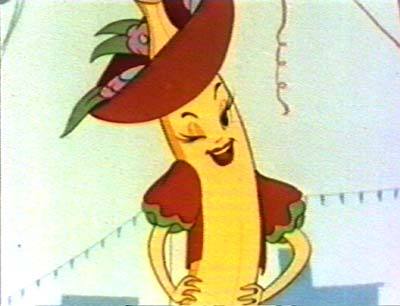
These days, Chiquita is a cartoon lady with a basket of bananas and other fruits on her head. In the past, she was actually a banana in a tropical style dress, frequently shown winking or posing seductively, ripe for the plucking. It’s a false suggestiveness. The bananas on large commercial plantations are actually virgin fruits. They have no seeds and are reproduced via parthenocarpy, or asexually. And however abundant the bananas in the hat, they are all depressingly the same. Endlessly propagated from the same genetic material, the type of banana cultivated for export is predictable enough to base a gigantic industry on. The fruits are picked green, packed in refrigerated containers, and chemically ripened at their destination. So Finley, the faithful little friend, can have his pile of bananas. And Oz, the pile of gold.

The Facebook Mystique

Betty Friedan, American feminist and writer.

Betty Friedan, American feminist and writer. (Photo credit: Wikipedia)

It’s funny that the origins of Facebook now seem historical. The fun of The Social Network was the wink-and-a-nod of knowing how it all turns out since audiences were already living in a world that had been transformed by friend requests and status updates. By the time the movie came out in 2010, “to facebook” had already entered the English language as a verb and in 2009 “unfriend” had won the vocab equivalent of an Oscar by being named Word of the Year. By now, the pre-Facebook period is practically the Pleistecene.

Time flies faster in the digital era. Facebook is now one of the world’s largest companies and its executives some of the world’s wealthiest people. This has ensured that the press rollout for the soon to be published book by Facebook COO Sheryl Sandberg (who was responsible for making the company profitable) has gotten some attention. Lean In: Women, Work, and the Will to Lead wants women to learn to lead by joining “lean in circles” for self-empowerment.

Sandberg’s book just happens to be coming on the heels of another publishing milestone in women’s history: the fiftieth anniversary of Betty Friedan’s The Feminine Mystique. 1963 sure was another era. Noreen Malone points out in Slate that when Friedan wrote about the long, boring days of the housebound hausfrau in Mystique, she definitely didn’t have Wi-Fi. If she’d had, she might have re-connected with her Smith classmates not at a reunion but via Facebook and the book might have been a blog. Instead, it became a social movement. She had to leave the house to get that going.

Although Friedan became an active part of the women’s movement of the 1960s and 70s, Feminine Mystique got a lot of criticism for saying it was about women but actually being about white, middle to upper-class women. Sandberg’s got it even tougher of course since she’s in the yet tinier demographic of self-made billionaire women. And so Friedan’s fiftieth and Sandberg’s first coming within a few weeks of each other has generated a lot of discussion of what feminism was, is, and should be. Friedan’s flaws might now be forgiven since hers was a historic moment but Sandberg is getting a lot of push back as an out of touch self-promoter. It may well be that her advice is more pragmatic than idealist and might only work for women who are also CEOs, but it’s worth noticing that she’s using her position to point out that there’s still some glass at the ceiling. Some of the criticisms of Sandberg echo those that the HBO show Girls has gotten for being about affluent, well-educated white young women. In a New Yorker review of the show, Emily Nussbaum questions this fretting over privilege and concludes that, “when there’s a tiny aperture for women’s stories. . . when almost no women are Hollywood directors, when few women write TV shows, of course it’s the privileged ones who get traction.” And even being Hollywood insiders doesn’t spare them the industry’s mockery–just ask Seth MacFarlane.

Which brings us back to The Social Network. Although more fiction than fact, it offered a nice little origin myth about the company’s founder as a smarty pants jerk who couldn’t figure out how to get people, especially girls, to like him. So he creates Facebook as a means of revenge against all the slights and snubs of the Harvard hotties and their frat boy hookups by offering an anonymous means of rating them hot, or not. It succeeds wildly and soon the character-based-on-Zuckerberg and his good friend Eduardo (before he’s viciously unfriended) are getting it on with two Asian American fangirls in a bar bathroom. The kindlier Eduardo manages to convert one of these women into a girlfriend. She later turns out to be a psycho Tiger Mom who hasn’t had kids yet, but that’s another story. (Note from Hollywood to model minorities: no matter how model, we’ll find a way to put you in your place.) Facebook’s founder remains sadly alone through the end of the movie when he gets some tough love advice from an über-competent female lawyer. This character seems like a proto-Sandberg. And so the movie begins with the practical, but common, woman who dumps him and ends with the practical and super-successful woman in a man’s world who just deals with it. In between, it’s pretty much girls, girls, girls even if they are all students at the nation’s most elite universities. These two scenes don’t quite save the movie from perpetuating stereotypes of women as bimbos just as Sandberg’s book fails to speak to the problems that women from outside the Ivy League are likely to face. But if the book puts another crack in the glass, well, that would be something.

Mrs. Lincoln’s Dress: Material Made History

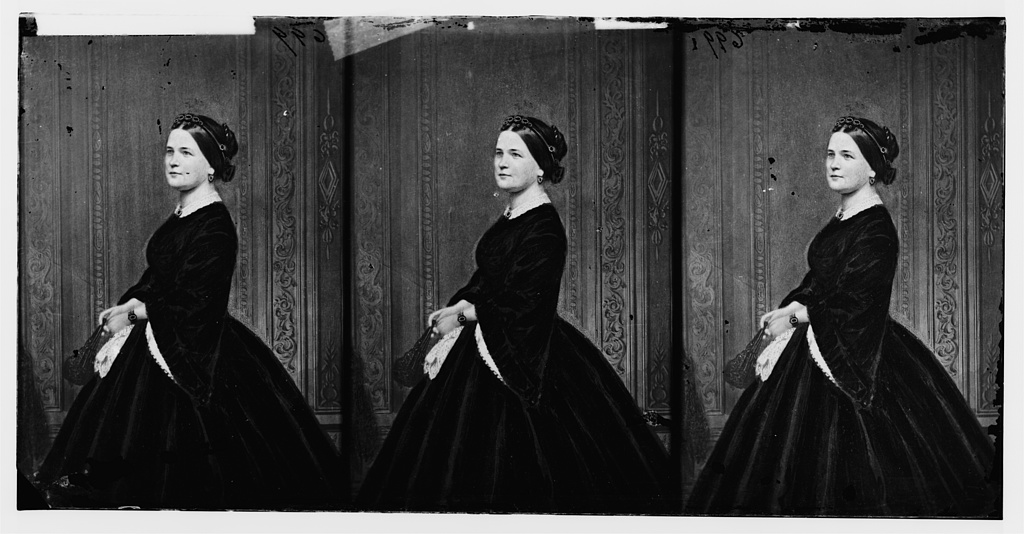
Mary Todd LincolnPhoto Credit: Library of Congress

Mary Todd Lincoln
Photo Credit: Library of Congress

There’s a reason that costume designers are nominated for Academy Awards. It takes nothing away from Sally Fields’ performance to say that Mrs. Lincoln’s dress animated Lincoln almost as much as its wearer. The dress—ok, the dresses—nearly had a life of their own. In the receiving line at the White House, Mrs. Lincoln’s ball gown makes her a force of nature not to be ignored and when she sinks to the floor to plead with Lincoln the way her everyday dress nearly engulfs her suggests exactly how her emotional mess threatens to swamp him. While designer Joanna Johnston certainly deserves credit for her thoughtful attention to Lincoln’s love for his shawl, just as the hairdresser did for Thaddeus Stevens’ wig, Mary Todd Lincoln’s dresses stole the show. Fields, as the Mrs., seems at times to be a daguerreotype come straight to life. Lincoln’s dramatic dresses surely owe something to the fact that the script was partly based on the book Mrs. Lincoln’s Dressmaker. Elizabeth Keckley was Mary Todd Lincoln’s dressmaker and friend but you’ve probably already heard the news that her career as a powerful business woman and powerbroker in the African American community of Washington D.C. didn’t quite make it into the movie. In defense of these and other omissions of black people (cf: post on Frederick Douglass below), the film’s makers point out that the movie is a work of historical fiction.

And so it is. How, after all, can one make a satisfying movie about a man whose voice was never recorded nor moving image ever filmed? This is the conundrum of the past: some of the things we most want to know are unknowable. Imagination helps to fill that void even as it insists on authenticity. That Johnston prohibited the use of plastic buttons even where invisible for any of the film’s 140 or so cast members’ costumes speaks to this. Abraham Lincoln looms too large in the American imagination for anything less to be acceptable. And since the movie is so very talky, we have plenty of time to look at the details and wonder at how vividly real it all seems. The truth about the 13th Amendment and how it came to pass surely lies elsewhere; the emotional satisfaction of seeing and hearing a convincing illusion of 1865 makes even two hours and thirty minutes seem short.

In this, Lincoln’s love of accuracy in all things material calls to mind hardcore Civil War reenactors. These often misunderstood enthusiasts first came to the attention of the wider world with the publication of Tony Horwitz’s Confederates in the Attic (1998). Robert Lee Hodge, dressed as a Confederate soldier and photographed with period technology, graced the cover of the book. Hodge took Horwitz on a tour of the hardcore underground where reenactors eschewed the least anachronism. They slept on the ground and spooned together for warmth, ate semi-rancid food out of common pots, and endured the blisters brought on by long marches in ill-fitting boots made to match a time period that did not distinguish left feet from right. Most memorably, Hodge so immersed himself in his quest for authenticity that he developed a marketable specialization: imitating the rigor mortis and bloating typical of dead soldiers in Civil War battlefield photographs.

People often find this level of obsession a little freakish, so much so that one recently engaged woman felt driven to write a light-hearted but also heartfelt explanation of the subculture titled, “So I’m Marrying a Reenactor.” The freak factor was still sufficient for National Geographic to do a one-off reality show titled “Extreme Civil War Reenactors.” (The word “hardcore” presumably sounded a little too much like the adult film industry.) The reenacting community remains divided on whether the hardcores are ruining or saving the pastime, but they march on regardless of mainstream ridicule. So it’s ironic that Daniel Day-Lewis is revered for his rigorous insistence on method acting that has led him to sleep out in the fields of Alabama and survive only on what he shot to prepare for Last of the Mohicans or to have fellow cast members spoon feed him while he played a disabled man in My Left Foot. And hardcores might teach Johnston a thing or two about buttons: they get just the right patina on their uniform buttons by peeing on them.

A Valentine for Frederick Douglass

Daguerreotype of Frederick Douglass

Daguerreotype of Frederick Douglass (Photo credit: Wikipedia)

As of this writing, Frederick Douglass still does not appear in Steven Spielberg’s Lincoln. Spielberg has gotten a lot of grief for this, as has his screenwriter Tony Kushner who started with a script that included Douglass but then left him out. The black characters who did make it into the film are mostly kindly, grateful, and token. Sure, there’s one angry black man at the start who’s intent on holding Mr. Lincoln accountable, but he isn’t Frederick Douglass and the other black soldier who is with him keeps laughing at Lincoln’s jokes. Spielberg’s Lincoln is in good company at this year’s Oscars though—Argo and Zero Dark Thirty have also been raked over the historical accuracy coals for what they left in, left out, or just plain made up. And in far off Chile, film director Pablo Larrain recently invoked Spielberg in defense of his Oscar nominated movie No in which a complicated social movement that led to a national referendum to oust dictator Augusto Pinochet is told primarily as the story of a single man and his ad campaign. Worse, many of the people who were actually involved are very much among the living and not all have had kind words for the film.

Frederick Douglass, we hope, is resting in peace. And since he will not be on screen this year and nor will any actor portraying him be on the red carpet at the Oscars next week, let’s remember him on this his birthday. Douglass chose Valentine’s Day to celebrate the day of his birth because his mother, who he saw only a handful of times during his childhood in slavery, called him her “little valentine.” He didn’t know his own birth date because, as he writes in his autobiography, no slave ever did. Even as a child he wondered why he was deprived of this privilege. It’s fitting that Douglass’s chosen birthday falls between that of Lincoln and Washington. There is a considerable distance between the two on the question of slavery and Douglass as much as anyone and more than most helped to move the country in the right direction. If this isn’t in the movie, well, Hollywood history has always left a lot on the cutting room floor and Spielberg is not a documentarian. Douglass is not in Lincoln. So here’s a thought: how about next year a movie titled Douglass for Best Picture?

Happy Birthday Mr. Lincoln-Lewis

Abraham Lincoln

Abraham Lincoln (Photo credit: The U.S. National Archives)

Given that Daniel Day-Lewis is known to inhabit his roles deeply—even texting Sally Fields as Abe—one wonders whether he feels like today is his birthday, too. It would be a well-deserved celebration. His Lincoln seems a daguerreotype come so to life that it is uncanny. Nor is this all. In Lincoln there are ghosts of other films and shades of other performances. With Daniel Day-Lewis as the lead these haunt the imagination. He has inhabited other roles and been especially at home in movies about the past.

Given the Civil War setting, his Bill the Butcher in Gangs of New York most immediately comes to mind. Bill was no Lincoln fan and the scene in which he throws a knife at a Lincoln poster seems mostly funny in retrospect. More striking is the other Lincoln in Gangs: the costumed actor from the cast of Uncle Tom’s Cabin who is suspended above the stage and directs the actions of the characters. As he proclaims, “And Topsy, dear little Topsy, cradle Uncle Tom’s head,” the Lincoln performer nervously eyes the audience. And with good reason—the play doesn’t so much end as erupt when the very tough crowd starts pelting the stage with rotten fruit. This, truly, is a performance of Lincoln in extremis. It’s this other Lincoln, this vaudeville hack who points to the greatness of Day-Lewis’s performances. The rendition of Uncle Tom’s Cabin in Gangs is supposed to be bad theater and audiences of the time generally were that rowdy. But it’s the faux-Lincoln’s declamation that steals the scene because it’s so marvelously bad. Sometimes it takes a dose of bad acting to set the real thing in relief.

In Gangs, one such moment comes when Bill rejects the notion that the Irish immigrants can become a part of America. He doffs his stovepipe hat—tall as Lincoln’s, but a good bit filthier—to reveal the greasiest case of hat head imaginable and explains that his father gave his life for this country, “murdered by the British with all of his men on the twenty-fifth of July, anno domini, 1814.” In another echo, and another reversal, a father murdered by the British also steps out of the past from Day-Lewis’s early role as Gerry Conlon in In the Name of the Father. Day-Lewis, as Conlon, must come to terms with his relationship to his father who is unjustly convicted for a role in an IRA bombing and dies while both are in a British prison. In Gangs, Leo DiCaprio seeks to understand his Irish father’s death at Bill’s hand. Got that? Day Lewis has played a Lincoln hater and Lincoln, an Irish victim and an Irish persecutor. Yet the role of the father, and of the son, resonates across each of these films. It’s Day-Lewis’s portrayal of Lincoln as a father who has lost one son, and who refuses to lose another, that makes the man real. That the father is then martyred makes it transcendent. Hats off to Lincoln-Lewis.

Three and a Half Weddings and a Funeral

British Female Munitions Worker

British Female Munitions Worker (Photo credit: Woodrow Wilson Presidential Library Archives)

The leading ladies of Downton have almost caught up with Hugh Grant and Andie MacDowell. Sybil, Mary, and Anna (yes, she’s a shadow sister) are all married. Edith got halfway married. And now Sybil is buried. So that makes three and a half plus one. One wonders of course whether the other half will be the forthcoming happy ending of season three, but since there’s only a little over a week to wait we can be patient. For the moment, Lady Edith remains unmarried and on the verge of turning into a career girl. For once, the historical reference for this plot line is both subtle and resonant. If Ernest Hemingway’s lost generation was mostly men, the other half of the sun that also rises was the generation of women who came of age with them. Back in Lady E’s day, poet and novelist Vera Brittain helpfully coined the term “superfluous woman” for all the single ladies left unwed by the war. Just a few years ago, Virginia Nicholson wrote a book titled Singled Out: How Two Million Women Survived without Men after the First World War. If Edith represents the high end of the trend—an educated woman of means who becomes (just guessing here) a crusading journalist—then kitchen maids Daisy and Ivy (btw: what’s up with the plant names?) represent the low—service workers who scrabble over the footmen. It’s a pity the scriptwriters didn’t think to come up with the third option: emigration. If we usually think of first world men importing third world women as picture brides, apparently British women were encouraged to take advantage of their vast imperial holdings and set out for India to husband hunt. Hmmm…a Downton Abbey: Empire Edition has real possibilities.

For now though, Edith remains tethered to the island. Her travails might be historically accurate but they are also notably of the moment. It’s been hard not to notice the full slate of “sex-marriage-mommy” magazine pieces that have made a big splash in the past year or two. If the lack of intellectual coherence in the genre that ranges from “Marry Him!” to “The End of Men” has made Pamela Erens in the L.A. Review of Books ask whether The Atlantic is making us stupid, its salience reminds us why Downton has done so well. As a group, its ladies and their domestics confront the modern girl’s every trial, tragedy and tribulation. As this post’s title suggests, most of these are by now resolved. Only Lady E’s fate remains to be seen. If one suspects—due to relentless conditioning over three seasons—that it will be a happy one, a word of caution. While Erens main point is that the recent high profile writings on the state of modern womanhood lack a crucial historical sense of feminism, one of the kickers in the piece is the news on how outnumbered women writers are at serious magazines and journals. So let’s cheer on Edith and her newspaper column. The world could use another woman writing.

Hyde Park on Hudson: All the President’s Women

Sara Roosevelt and her son, President Franklin...

Sara Roosevelt and her son, President Franklin D. Roosevelt, in 1933 at the family estate in Hyde Park, New York (Photo credit: Wikipedia)

What is it with the great liberal presidents and their women? It’s not that FDR’s cheating ways were a secret. His affair with his secretary Lucy Mercer was a key catalyst for Eleanor’s rise to greatness as a first lady who transcended both the office and her presidential spouse. Certainly there are shades of the Clintons here. But FDR’s first big affair is not the central story of Hyde Park on Hudson. Instead, we’re introduced to the story—fictionalized here, but apparently plausible based on the evidence—of his seduction of his distant cousin Daisy. She, not unlike the innocent viewer, stumbles into a romance that can only be understood as such by someone who is entirely naïve about the ways of the world. Since the romance isn’t a romance but rather an instance of a charming but old man putting the moves on a much younger woman who’s not really in a position to resist. There’s one kind of movie in that story line, but enfolding it into another movie that’s full of the kind of misty-eyed nostalgia that Americans have for the Great Depression and World War II era makes for an odd mix. The movie tries to resolve these two stories by suggesting that we must understand how hard it was for FDR to take care of everyone. Democracy, after all, is not the same as monarchy which is why FDR gets to play father figure to the poor old King of England who stutters and lets himself be henpecked. In the end, FDR must bear the burden of keeping up not just the spirits of the Americans as they slog through the Depression, but of the entire free world as the Nazi threat draws nigh. In Hyde Park on Hudson, the re-creation of FDR doing his jaunty cigarette-holder smile photo makes it clear just how hard that magic act was on the worn down and physically incapacitated president.

And so the women fall for it. Recently in The Atlantic, Caitlin Flanagan wrote about her ongoing romance with JFK. Like any good co-dependent girlfriend, she describes herself as constantly backsliding. She swears him off, calls herself a fool, and then it happens: she looks at the pictures of Kennedy with little John John and Caroline again. And in a flash the player-in-chief disappears. Even after reading the most recent Kennedy mistress tell-all, in which it becomes clear that very little was sacred to the President, Flanagan falls for him again. “Let him have the girls, I thought; he could handle the girls and still put in an ace performance as Father of the Century.”

What does showing FDR’s creepy old man side do for a very different, if no less beloved, icon of the twentieth-century? In the key scene of HPoH, when he puts his country cousin Daisy’s hand on his knee, we are directed to focus on the age spots and wrinkles of that hand. FDR is not just the national father figure, he’s the national grandfather except, of course, for the rather notable absence of any children in the movie. They’re substituted by the adults, who sometimes act like children and play strange little games with each other. The women seem caught in a particularly sad situation. The best thing anyone finds to say about Eleanor is that she’s “realistic;” Mrs. Roosevelt (FDR’s mother) is in denial even as she plays the procuress; the queen is anxious and hopelessly uptight; the secretary is fated to die; and Daisy herself realizes that her choices boil down to servicing the president or getting on her knees to help her aging mother put her stockings on. And so it’s odd that the film ends happily. England is saved, the King eats his hot dog (and likes it!), and the harem plays bridge together. Only poor old FDR is left isolated and debilitated, his heroic service to the nation soon to be rewarded with a deadly stroke.  There may be some psychological truth to this but it leaves one wishing for the rather different presidential woman that Laura Linney played so memorably in another role. Abigail Adams would have set Daisy straight.

Downton Abbey: Titanic Class Divides

Titanic stern

Titanic stern (Photo credit: Wikipedia)

Really, using the Titanic as the catalyst for the plot of Downton Abbey is brilliant. It’s shamelessly, fiendishly effective since everyone already knows that story so well. If anything, the Titanic backstory fades away too quickly. The brief, season two attempt to resurrect it through the cousin who survived the sinking—or did he?—seems to have foundered. Even for a show that’s a telenovela wolf dressed up as a Masterpiece Theater sheep, pulling out a disfigured amnesiac was a bit much. But who knows? Maybe he’ll come back as Lady Edith’s suitor yet, although only after benefitting from some kind of miraculous advance in plastic surgery. And why not, in a show that seems of be taking some scriptwriting tips from the book of books: The blind receive their sight, and the lame walk, the lepers are cleansed, and the deaf hear, the dead are raised up, and the poor have the gospel preached to them. (Matthew 11:5)

Perhaps this last point really drives the show’s Titanic theme. Julian Fellowes, while working on his other show, called out James Cameron for making First Officer William Murdoch into a villain in his Titanic. Fellowes makes sure we know that Cameron dishonored an officer and a gentleman. As a good D.A. watcher could tell you, there’s hardly any greater sin than this. The controversy, such as it is, could not be more telling. On Cameron’s Titanic, an upstairs / downstairs romance might drive the plot, and the sumptuous sets and costuming might feed our vicarious desires to see how the other half lives, but Leo DiCaprio’s steerage-class Irish immigrant is not just a heartthrob but a genuine populist hero. Downton Abbey’s Irish class rebel, Tom the chauffeur, can hardly compare. He might steal Lady Sybil but his revolutionary rabble rousing is just so much hot air and when push comes to shove, he dresses for dinner and sheds a tear for the aristocrats whose castle is burned down. Billy Zane’s Cal chasing after Leo with a gun through ballrooms filling with water might qualify as melodramatic fantasy but it’s clearly class war. We know whose side Cameron is on. Downton Abbey endlessly pantomimes keeping it real by playing the servants-as-people-who-deserve-to-be-treated-as-such card. Yet really this device is mostly employed to keep the aristocrats sympathetic characters. Thought experiment: what if Cameron were at the helm of the good ship Downton?

Zombies and Vampires: They Just Keep Coming Back

Zombie Walk in Edmonton

Zombie Walk in Edmonton (Photo credit: Wikipedia)

“The lies of the past were long gone and now the truth was everywhere, shambling down their streets, crashing through their doors, clawing at their throats.” World War Z

Does the zombie apocalypse speak truth to power about the past? It might seem so from looking at how zombies and vampires just keep coming back. Although set in the future, in World War Z: An Oral History of the Zombie War author Max Brooks nods to Studs Terkel’s The Good War an oral history that chronicled American experiences during World War II. (And for those of you who haven’t read it, note that Terkel’s title is ironic—it’s not at all clear that many of those interviewed believed in the goodness of World War II.) Abraham Lincoln: Vampire Hunter turns plantation owners and Confederates into the other undead. It might not be good history but it vividly captures the sense of horror that plantation slavery and the carnage of the Civil War evoke. Zombies and vampires: the past that persists, the history that has to be confronted.

It turns out that zombies and vampires make perfect metaphors for just about everything that comes back to haunt us. Inept policies in response to a severe recession sparked by a mortgage meltdown created a zombified economy, according to Paul Krugman. And it’s hardly a stretch to link vampires to debt collectors. As David McNally points out in his Monsters of the Market: Zombies, Vampires and Global Capitalism, folklore has long used monster metaphors to characterize predatory economies. On the political side, the legions of zombies and vampires haunting popular culture might also be the ghosts of foreign policy past. Zombies, of course, literally came to Americans’ attention after the United States Marines occupied Haiti from 1915 to 1934. The tragedy of 9/11 exposed other fissures that most Americans became aware of only in its aftermath. The abstractness of the threat that the event implied made responding to it directly difficult. In Wired, Spencer Ackerman has compared the war on terror to a zombie “lurching forward thoughtlessly on instinct.” Nor are zombieism and vampirism purely American metaphors. The recent Cuban film Juan of the Dead makes Fidel himself the last zombie standing while Latin Americans have long had their stories of chupacabras (animal vampires) that correlate to hard times.

Zombies and vampires are everywhere and in this they also closely resemble the most powerful current keeper of our collective past: the internet. Facebook has been around for just under a decade now but one of its current worries is what to do with its own “zombies”: the Facebook pages of deceased users. Yet it’s the living who have more to worry about from being haunted by posts past. This is now the first generation coming of age who cannot re-invent themselves when they go off to college or otherwise sail into adulthood. Their past persists and it’s not unlike the student debt many will face. Unlike other kinds of debt, student loan obligations cannot be discharged through bankruptcy proceedings and can, vampire-like, seemingly persist for all time. Little wonder that such monsters appeal to boys and girls alike. Vampires might be from Venus and zombies from Mars, but there’s something there for everyone.

So welcome to the past persistent, but I have a warning for you, or maybe it’s for me. This blog post? Undead.