pastpersistent

the past in pop culture

Category: History

The Descent of Their Last End: A Son of Erin Returns Home

Smoking pipe fragments excavated at Duffy’s Cut, Pennsylvania. Some of the pipes clearly made in Ireland. Duffy’s Cut Museum, Immaculata University. (Photo Credit: Wikipedia)

After 181 years, John Ruddy has returned to Ireland to be buried among his ancestors at a funeral attended by descendants. In an earlier post, Royal Reliquaries, or Who Do You Think You Are?, we wrote about how DNA testing, archaeology, and forensic science have solved mysteries about the past both for the famous and for the forgotten. Richard III’s remains were recently identified, but so were John Ruddy’s. In the spring of 1832, John Ruddy and a number of other Irishmen sailed to Philadelphia and were hired straight off the boat to work on building one of the country’s earliest rail lines. Barely two months later, as a cholera epidemic raged, Ruddy and fifty-six others died at a site known as Duffy’s Cut.

Locals long believed that the mass grave contained men who were victims of the disease and that this accounted for the many eerie stories associated with the site. But a team of historians and students from nearby Immaculata University discovered when they began excavating the bodies, that some had died by violence. Forensic evidence suggests that some of the six men, and one woman, whose graves have been excavated so far, were murdered. The hypothesis is that local vigilantes wanted to prevent them from leaving the camp to get medical help and supplies for the many men who were sick with the cholera. Of these bodies, they were only able to positively identify John Ruddy due to a rare genetic abnormality that affected his teeth and that several present-day Ruddy family members share.

Members of the Duffy’s Cut project had the six who are unidentified reinterred at Philadelphia’s West Laurel Hill Cemetery last year. On March 2, 2013, Bill Watson, Frank Watson, and Earl Schandelmeier of the Duffy’s Cut Project, along with Sadie, James, and Bernard Ruddy, accompanied John Ruddy’s casket to its final resting place in Ardara, County Donegal, Ireland. In 1832, John Ruddy was just eighteen years old, a poor Irish immigrant who needed any work he could find when he made his westward journey, first to Philadelphia and then just thirty more miles to a cut in the woods. He has returned to Ireland at last.

On the Good Ship Frederick Douglass

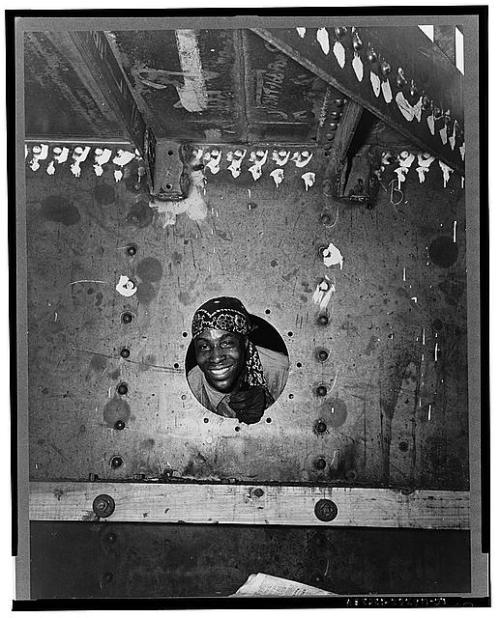
Building the SS Frederick Douglass. Smiling from the porthole is rivet heater Willie Smith. (Photograph by Roger Smith, Office of War Information, Library of Congress Prints and Photographs Division)

Building the SS Frederick Douglass. Smiling from the porthole is rivet heater Willie Smith. (Photograph by Roger Smith, Office of War Information, Library of Congress Prints and Photographs Division)

[Weekly Writing Challenge: Truth is Stranger than Fiction

“For this challenge, we want to see a photo of someone looking truly happy. . . Then we want to know why: what’s going on in the photo? . . . We’re sure you could invent Hollywood mega-hit-worthy explanations for your subject’s happiness . . . but this week, we’d rather know what’s real.”]

This year’s best picture nominees, and ultimately the winner of that award, took on some big topics in American history: U.S. involvement overseas (Argo and Zero Dark Thirty) and slavery (Lincoln and Django Unchained). To varying degrees, each of these four films dealt in the truth but made it into movies their makers called fiction. Argo underplayed the Canadians and made up some drama. Torture didn’t quite work out the way ZDT played it. Django seemed almost purely fantastical but check out the true story of Dangerfield Newby and think again. And Lincoln? Lincoln left out Douglass making the movie a little narrower than it ought to have been.

In truth, Frederick Douglass looms too large to be left out. In this photo taken by Roger Smith for the Office of War Information, we see a worker identified as Willie Smith. Smith smiles delightedly out of a porthole in the dock house of a ship named after Douglass. The time is May, 1943. The location is the Bethlehem-Fairfield Shipyard in Baltimore, Maryland. The photograph’s original caption informs us that this shipyard is roughly where Douglass, while still a slave in the 1830s, was sent to work by his master to earn extra money working as a caulker. Douglass recounts in his Narrative that as a child of twelve, he had learned to write partly by watching ship’s carpenters at the Baltimore yards mark boards with letters for different sides of the ship. Later, when Douglass returned to Baltimore as a young man (after having had a knock-down, drag out fight with a slave breaker who ended up being the one broken), he was apprenticed out to the shipyard. He was there for months until one day the white apprentice carpenters started objecting to working with black men and set upon him. Tarantino might take note of Douglass’s description of the fight:

“[They] came upon me, armed with sticks, stones, and heavy handspikes. One came in front with a half brick. There was one at each side of me, and one behind me. While I was attending to those in front, and on either side, the one behind ran up with the handspike, and struck me a heavy blow upon the head. It stunned me. I fell, and with this they all ran upon me, and fell to beating me with their fists. I let them lay on for a while, gathering strength. In an instant, I gave a sudden surge, and rose to my hands and knees. Just as I did that, one of their number gave me, with his heavy boot, a powerful kick in the left eye. My eyeball seemed to have burst. When they saw my eye closed, and badly swollen, they left me. With this I seized the handspike, and for a time pursued them. But here the carpenters interfered, and I thought I might as well give it up. It was impossible to stand my hand against so many. . .”

Although Douglass couldn’t return to work there, his master later sent him out to another yard where he learned to caulk the hulls of ships. When he finally escaped to freedom in Massachusetts, he tried to get similar work in the shipyards of Nantucket, only to find that the white workers there also excluded free black men from such skilled professions. (Back in Baltimore, free black workers formed a Caulkers Union in 1838 and used it to insist on being paid fair wages. They succeeded until 1865,when white workers went on strike to force the shipyard owners to fire the black men.)

If we fast forward to the time of the photograph of riveter Willie Smith, we can start to understand some of the reasons for his joy. Slavery, of course, had long since ended, due in no small part to the leadership of individuals like Douglass. Job discrimination persisted, however, even as the nation mobilized in support of a war against fascism. Only the threat of a full scale march on Washington by A. Philip Randolph in 1941 finally convinced President Franklin Roosevelt to issue Executive Order 8802 that prohibited discrimination based on race, creed, color, or national origin in the defense industries. But black workers still faced segregation both in the military and on the home front. Workers at the Bethlehem Fairfield Shipyards remained segregated through the end of the war. Another photograph from the Office of War Information attests to how far this went:

A Drinking Fountain, Bethlehem-Fairfield Shipyards (Photo by Arthur Siegel, Office of War Information, Library of Congress Prints and Photographs Division)

A Drinking Fountain, Bethlehem-Fairfield Shipyards (Photo by Arthur Siegel, Office of War Information, Library of Congress Prints and Photographs Division)

Yep, white only drinking fountains for workers building ships for the United States government in Maryland–hardly the deep South.

Still Willie Smith smiles. We might take a minute to consider who he’s smiling at. The photographer is Roger Smith, probably no relation to Willie. Roger Smith worked for the Negro News Division of the Office of War Information. Although a prolific photographer who extensively documented African American participation in the war effort, he remains very little known. The single best measure of this is probably the fact that of the twelve Roger Smiths listed on Wikipedia, as of this writing he is not one of them. What is known is that his work was marginalized and that as a black photographer, he mostly got assigned to photograph black subjects.

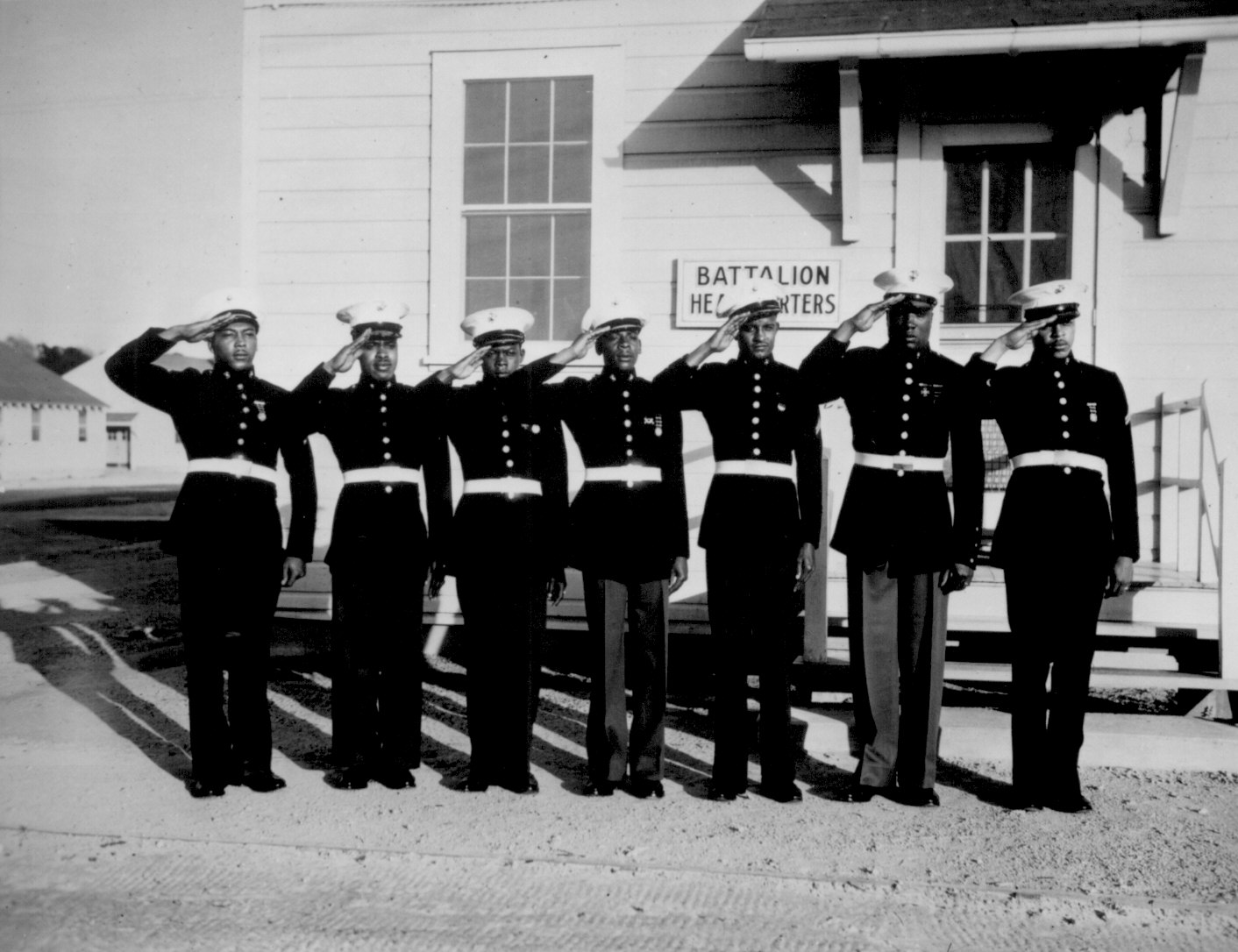
He did so brilliantly. He is especially notable for having photographed the country’s first black Marines.
"... Although a dress uniform is not a part of the regular equipment, most of the Negro Marines spend $54 out of their pay for what is generally considered the snappiest uniform in the armed services... Photo shows a group of the Negro volunteers in their dress uniforms." Ca. May 1943. Roger Smith. (Library of Congress Prints and Photographs Division)

“… Although a dress uniform is not a part of the regular equipment, most of the Negro Marines spend $54 out of their pay for what is generally considered the snappiest uniform in the armed services… Photo shows a group of the Negro volunteers in their dress uniforms.” Ca. May 1943. Roger Smith. (Library of Congress Prints and Photographs Division)

These men are not smiling, but surely that was because this formal photograph was intended to show their seriousness of purpose. It might also have been because their battles still lay ahead. The Marines were the last branch of the United States military to allow African Americans to enlist, and until 1949, they were housed at a segregated camp called Montford Point. In 2012, the surviving members of the group (known informally as the Montford Point Marines) were awarded the Congressional Gold Medal, the country’s highest civilian honor, in recognition of the discrimination they had faced—including having been excluded from combat roles. However overdue, Frederick Douglass might have smiled. At the start of Lincoln, the black soldiers who we see fighting in the film’s only combat sequence took part in the Civil War thanks in large measure to Douglass’s relentless advocacy to the Lincoln administration. This didn’t make it into the film, but it happened.

And so Willie Smith, who played the smallest of parts in the largest of wars, smiles, too. He knows what his photograph means.

(Postscript: The ship Smith helped to build, the SS Frederick Douglass, was a freighter. Perhaps this is unsurprising given that African American soldiers were generally assigned to support roles rather than combat during World Wars I and II. The ship and its mixed race crew was under the command of Captain Adrian Richardson, only the second black man appointed to such a position during the war. A German U-boat sank the Douglass on September 20, 1943 as part of a larger assault on the New York bound convoy of U.S. warships. A British ship rescued the Douglass’s entire crew, plus “one female stowaway.” This is also a true story.)

Mrs. Lincoln’s Dress: Material Made History

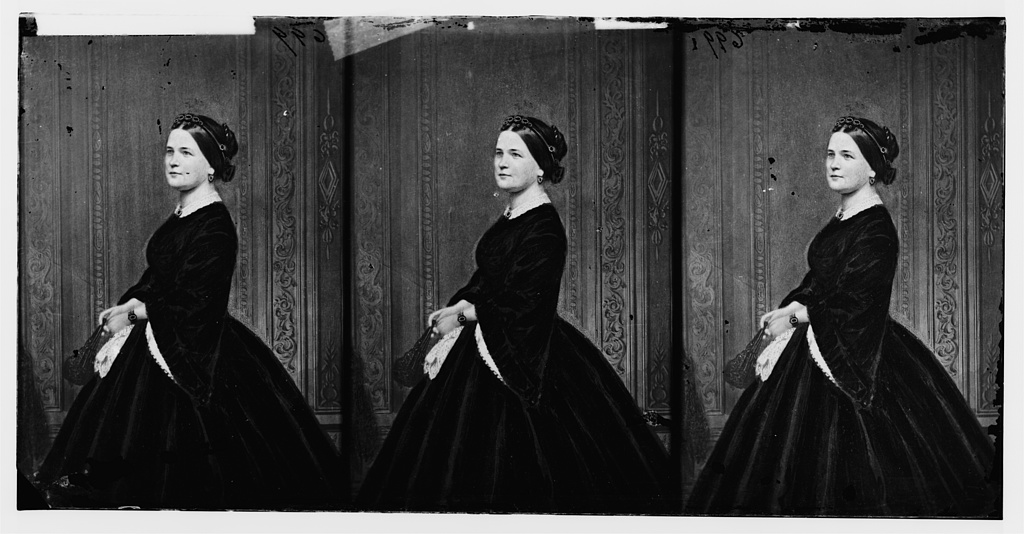
Mary Todd LincolnPhoto Credit: Library of Congress

Mary Todd Lincoln
Photo Credit: Library of Congress

There’s a reason that costume designers are nominated for Academy Awards. It takes nothing away from Sally Fields’ performance to say that Mrs. Lincoln’s dress animated Lincoln almost as much as its wearer. The dress—ok, the dresses—nearly had a life of their own. In the receiving line at the White House, Mrs. Lincoln’s ball gown makes her a force of nature not to be ignored and when she sinks to the floor to plead with Lincoln the way her everyday dress nearly engulfs her suggests exactly how her emotional mess threatens to swamp him. While designer Joanna Johnston certainly deserves credit for her thoughtful attention to Lincoln’s love for his shawl, just as the hairdresser did for Thaddeus Stevens’ wig, Mary Todd Lincoln’s dresses stole the show. Fields, as the Mrs., seems at times to be a daguerreotype come straight to life. Lincoln’s dramatic dresses surely owe something to the fact that the script was partly based on the book Mrs. Lincoln’s Dressmaker. Elizabeth Keckley was Mary Todd Lincoln’s dressmaker and friend but you’ve probably already heard the news that her career as a powerful business woman and powerbroker in the African American community of Washington D.C. didn’t quite make it into the movie. In defense of these and other omissions of black people (cf: post on Frederick Douglass below), the film’s makers point out that the movie is a work of historical fiction.

And so it is. How, after all, can one make a satisfying movie about a man whose voice was never recorded nor moving image ever filmed? This is the conundrum of the past: some of the things we most want to know are unknowable. Imagination helps to fill that void even as it insists on authenticity. That Johnston prohibited the use of plastic buttons even where invisible for any of the film’s 140 or so cast members’ costumes speaks to this. Abraham Lincoln looms too large in the American imagination for anything less to be acceptable. And since the movie is so very talky, we have plenty of time to look at the details and wonder at how vividly real it all seems. The truth about the 13th Amendment and how it came to pass surely lies elsewhere; the emotional satisfaction of seeing and hearing a convincing illusion of 1865 makes even two hours and thirty minutes seem short.

In this, Lincoln’s love of accuracy in all things material calls to mind hardcore Civil War reenactors. These often misunderstood enthusiasts first came to the attention of the wider world with the publication of Tony Horwitz’s Confederates in the Attic (1998). Robert Lee Hodge, dressed as a Confederate soldier and photographed with period technology, graced the cover of the book. Hodge took Horwitz on a tour of the hardcore underground where reenactors eschewed the least anachronism. They slept on the ground and spooned together for warmth, ate semi-rancid food out of common pots, and endured the blisters brought on by long marches in ill-fitting boots made to match a time period that did not distinguish left feet from right. Most memorably, Hodge so immersed himself in his quest for authenticity that he developed a marketable specialization: imitating the rigor mortis and bloating typical of dead soldiers in Civil War battlefield photographs.

People often find this level of obsession a little freakish, so much so that one recently engaged woman felt driven to write a light-hearted but also heartfelt explanation of the subculture titled, “So I’m Marrying a Reenactor.” The freak factor was still sufficient for National Geographic to do a one-off reality show titled “Extreme Civil War Reenactors.” (The word “hardcore” presumably sounded a little too much like the adult film industry.) The reenacting community remains divided on whether the hardcores are ruining or saving the pastime, but they march on regardless of mainstream ridicule. So it’s ironic that Daniel Day-Lewis is revered for his rigorous insistence on method acting that has led him to sleep out in the fields of Alabama and survive only on what he shot to prepare for Last of the Mohicans or to have fellow cast members spoon feed him while he played a disabled man in My Left Foot. And hardcores might teach Johnston a thing or two about buttons: they get just the right patina on their uniform buttons by peeing on them.

A Valentine for Frederick Douglass

Daguerreotype of Frederick Douglass

Daguerreotype of Frederick Douglass (Photo credit: Wikipedia)

As of this writing, Frederick Douglass still does not appear in Steven Spielberg’s Lincoln. Spielberg has gotten a lot of grief for this, as has his screenwriter Tony Kushner who started with a script that included Douglass but then left him out. The black characters who did make it into the film are mostly kindly, grateful, and token. Sure, there’s one angry black man at the start who’s intent on holding Mr. Lincoln accountable, but he isn’t Frederick Douglass and the other black soldier who is with him keeps laughing at Lincoln’s jokes. Spielberg’s Lincoln is in good company at this year’s Oscars though—Argo and Zero Dark Thirty have also been raked over the historical accuracy coals for what they left in, left out, or just plain made up. And in far off Chile, film director Pablo Larrain recently invoked Spielberg in defense of his Oscar nominated movie No in which a complicated social movement that led to a national referendum to oust dictator Augusto Pinochet is told primarily as the story of a single man and his ad campaign. Worse, many of the people who were actually involved are very much among the living and not all have had kind words for the film.

Frederick Douglass, we hope, is resting in peace. And since he will not be on screen this year and nor will any actor portraying him be on the red carpet at the Oscars next week, let’s remember him on this his birthday. Douglass chose Valentine’s Day to celebrate the day of his birth because his mother, who he saw only a handful of times during his childhood in slavery, called him her “little valentine.” He didn’t know his own birth date because, as he writes in his autobiography, no slave ever did. Even as a child he wondered why he was deprived of this privilege. It’s fitting that Douglass’s chosen birthday falls between that of Lincoln and Washington. There is a considerable distance between the two on the question of slavery and Douglass as much as anyone and more than most helped to move the country in the right direction. If this isn’t in the movie, well, Hollywood history has always left a lot on the cutting room floor and Spielberg is not a documentarian. Douglass is not in Lincoln. So here’s a thought: how about next year a movie titled Douglass for Best Picture?

Carnival is Over and Other Sinking Feelings

English: Pieter II Brueghel (the Younger) (156...

English: Pieter II Brueghel (the Younger) (1564-1638). The Fight Between Carnival and Lent. Copy of a painting by Pieter I Brueghel (the Elder). Royal Museums of Fine Arts of Belgium, Brussels, Belgium. Detail (Photo credit: Wikipedia)

Yesterday’s Fat Tuesday is today’s Ash Wednesday and a time for sober reflection. It’s been a rough week for ancient traditions. A pope stepped down for the first time since 1294. In Venice, where carnival has been celebrated since even before that time, revelers had to wade through high waters and melting snow in the sinking city. In Brazil, a carnival float caught fire and killed four too soon after that country’s deadly nightclub fire earlier this month. And somewhere on the Gulf of Mexico, a ship by the name of Carnival Triumph continues to drift after an engine room fire left it without power. Its four thousand plus passengers now face conditions remarkably like those of eighteenth and nineteenth century steerage class. The stench and filth below has driven some to sleep in tents on deck. Passengers report scarce food, long lines, and bad behavior. There are fears of disease and worries about the health of the elderly and handicapped. It’s no doubt a blessing for the cruise company that the lack of power has left people largely unable to use their cellphones and other such devices: so far, most of these reports are not accompanied by pictures. With luck, the beleaguered travelers will be towed to port in Alabama by today. They can, at least, be thankful they didn’t meet the fate of the passengers of the Costa Concordia—another ship belonging to the Carnival company. After running it aground, the captain decided to get off before his passengers had been rescued. What’s next? Women and children last? Yes, that too. Not even on our beloved Titanic where the captain did indeed go down with his ship were the male passengers quite as self-sacrificing as they have often been portrayed. While women and children mostly survived from first and second class, in steerage the rates were reversed. At least on the Titanic the captain gave the order to save women and children first. In most maritime disasters, survival rates were highest for the crew, followed by the captains (!), then women, and children dead last. Turns out that the real rule has been every man for himself. It seems unlikely that the Carnival line will re-name itself Lent any time soon, but it’s a thought.

Happy Birthday Mr. Lincoln-Lewis

Abraham Lincoln

Abraham Lincoln (Photo credit: The U.S. National Archives)

Given that Daniel Day-Lewis is known to inhabit his roles deeply—even texting Sally Fields as Abe—one wonders whether he feels like today is his birthday, too. It would be a well-deserved celebration. His Lincoln seems a daguerreotype come so to life that it is uncanny. Nor is this all. In Lincoln there are ghosts of other films and shades of other performances. With Daniel Day-Lewis as the lead these haunt the imagination. He has inhabited other roles and been especially at home in movies about the past.

Given the Civil War setting, his Bill the Butcher in Gangs of New York most immediately comes to mind. Bill was no Lincoln fan and the scene in which he throws a knife at a Lincoln poster seems mostly funny in retrospect. More striking is the other Lincoln in Gangs: the costumed actor from the cast of Uncle Tom’s Cabin who is suspended above the stage and directs the actions of the characters. As he proclaims, “And Topsy, dear little Topsy, cradle Uncle Tom’s head,” the Lincoln performer nervously eyes the audience. And with good reason—the play doesn’t so much end as erupt when the very tough crowd starts pelting the stage with rotten fruit. This, truly, is a performance of Lincoln in extremis. It’s this other Lincoln, this vaudeville hack who points to the greatness of Day-Lewis’s performances. The rendition of Uncle Tom’s Cabin in Gangs is supposed to be bad theater and audiences of the time generally were that rowdy. But it’s the faux-Lincoln’s declamation that steals the scene because it’s so marvelously bad. Sometimes it takes a dose of bad acting to set the real thing in relief.

In Gangs, one such moment comes when Bill rejects the notion that the Irish immigrants can become a part of America. He doffs his stovepipe hat—tall as Lincoln’s, but a good bit filthier—to reveal the greasiest case of hat head imaginable and explains that his father gave his life for this country, “murdered by the British with all of his men on the twenty-fifth of July, anno domini, 1814.” In another echo, and another reversal, a father murdered by the British also steps out of the past from Day-Lewis’s early role as Gerry Conlon in In the Name of the Father. Day-Lewis, as Conlon, must come to terms with his relationship to his father who is unjustly convicted for a role in an IRA bombing and dies while both are in a British prison. In Gangs, Leo DiCaprio seeks to understand his Irish father’s death at Bill’s hand. Got that? Day Lewis has played a Lincoln hater and Lincoln, an Irish victim and an Irish persecutor. Yet the role of the father, and of the son, resonates across each of these films. It’s Day-Lewis’s portrayal of Lincoln as a father who has lost one son, and who refuses to lose another, that makes the man real. That the father is then martyred makes it transcendent. Hats off to Lincoln-Lewis.

Royal Reliquaries, or Who Do You Think You Are?

Richard III Royal Collection

Richard III Royal Collection (Photo credit: Wikipedia)

Richard III’s bones were found under a car park, Henri IV’s head was kept in a jar, Louis XVI’s blood was soaked into a decorative gourd. All of these remains were recently proved real by DNA testing and publicized with splashy press releases. Each had met a violent end: Richard hit over the head on Bosworth Field by a pretender to the throne, Henri stabbed to death by a religious fanatic, Louis guillotined by revolutionaries. None of those stories were ever in doubt yet the positive identification of these relics has made international news. One wonders why. Ghoulish fascination? Henri’s head was, after all, mummified. Perhaps it’s related to the rise of the royals as pop culture icons. Even more than her wedding, Lady Di’s funeral brought the world to a standstill. It might be all those forensic science shows. What’s been called the “CSI effect”—or our television induced belief that we know our way around a crime scene—has proved strong enough that it’s changing not only the behavior of jurors (who now expect evidence to be DNA tested) but also that of criminals (who have learned how to destroy crime scene DNA traces). A mixed blessing to say the least.

Our relationship with DNA testing is fraught. The CSI effect has also tended to make people believe in the infallibility of the process when, in reality, genetic matches are based on probabilities and not certainties. Belief, in other words, hinges on faith even now. Reliquaries always relied on magical thinking for their power. The image on the Shroud of Turin can be proved a fake over and over and yet its power persists: the image is miraculous. With bodily relics, the science and the magic come together. Royalty, after all, can only be maintained by a belief in bloodlines. In a world where royals exist outside of real political power, we can trade skepticism for escapism with little harm.

Yet if forensic science can ratify the fame of the named, it can do the same for the nameless. While the power of DNA evidence in popular culture feeds our fairytale fantasies, it also fuels our desire for justice. It goes far beyond the wrongly convicted who are freed by the analysis of a decades old crime scene sample or the coldest of cold cases that finally comes to a conclusion. Ordinary people have bloodlines, too. Ancestry.com has made a fortune off of this insight and its ingenious infomercial series, Who Do You Think You Are?, managed to sprinkle star dust on genealogical research. Ancestry, of course, is record and not DNA-driven, but when African Americans Blair Underwood and Emmitt Smith guest starred on the show their ancestral searches took inevitable turns toward genetic science. For some people, the paper trails stop cold. After the Middle Passage, the enslaved lost their connections to their homelands and only the rise of DNA databases has been able to bridge that gap. Smith located part of his ancestry in Benin, while Underwood got to meet a (very) distant cousin in Cameroon who seemed a little confused by the premise of the show but threw a party anyway.

These DNA matches aren’t perfect. But they’re also close enough to the truth that no one can deny what they reveal. Witness the recent announcements about Michelle Obama’s mixed race ancestry and the discomfort it has caused for what it says about the American past. DNA-based revelations about Thomas Jefferson and his slave Sally Hemings certainly helped lead to the recent statement by a well-known scholar that Jefferson was “one of the most deeply creepy people in American history.” Skeletons just don’t stay in the closet anymore. Even now archaeologists are exhuming the bodies of the mistreated and forgotten at a Florida reform school. In Pennsylvania, at a site called Duffy’s Cut, a team of dedicated historians, students, and scientists have dug up the remains of Irish railroad workers believed to have died of cholera in 1832 and revealed that they were murder victims. One was identified as John Ruddy in part by an abnormality in his teeth that matched that of living descendants. They hope to repatriate the body to Ireland. If so, Ruddy will be like Richard. Both king and commoner can rest in peace at last.