pastpersistent

the past in pop culture

Month: March, 2013

Extreme Couponing on the Prairie

Little House on the Prairie book - original cover

Little House on the Prairie book – original cover (Photo credit: Wikipedia)

Laura Ingalls Wilder often wrote about stockpiling food in her childhood homes. From the big woods of Minnesota to the barren plains of North Dakota, making it on the frontier meant having enough food to last the winter. For the extreme couponers of TLC’s reality show, stockpiling runs year round. Revealing walls of paper towels in the garage, racks of soup cans in the kid’s closet, and tubs of toothpaste under the bed, featured couponers revel in their readiness not for a single winter, but for years to come. These underground bunkers of abundance bring out the armchair psychologist in all of us. Where couponers see thrift and prudence, the audience sees OCD and hoarding. To this, one woman on the show replied that hoarders’ piles have dust on them. And that makes all the difference.

It’s odd how much a frontier mentality pervades Extreme Couponing. In reality (the real reality), the very idea of couponing is about as far removed as possible from the hardship of breaking the plains. Exploiting coupons and in-store policies like doubling designed to lure customers in is only possible given the depth and breadth of the American consumer market. If everybody tried to use coupons extremely, they’d quickly be phased out. The system only works because most people, most of the time pay full price. It doesn’t feel like that between the shoppers’ rewards cards and daily specials but we all know that these are just loss leaders. Those who manage to really game the system do so by virtue of heroic effort. They forage for coupons in dumpsters, burn the midnight oil strategizing over their spreadsheets, and wrangle herds of carts through parking lots and grocery aisles.

The extreme couponers present themselves as individualists making it on their own on the harsh plains of post-recession America. One of the plot points on every segment of the show is the moment when each woman—and the occasional man—explains why they turned to couponing. A job loss, unexpected pregnancy, or other family emergency often lurks in the background. Once the system failed them, they were forced to set out on their own and figure out how to feed a family on next to nothing. A few even supplement their couponing habit with deer hunting and gardening. Most, though, live nowhere wilder than suburbia where all the housing looks depressingly the same and the appeal of turning the basement into a personal mini-mart seems sadly universal.

Although one mother on the show tells her children that “free always tastes better,” one wonders. As the narrator helpfully points out in another segment, coupons are never for fresh produce and rarely for meat or dairy. Just as the Great Plains were much less fertile than land speculators claimed they were, coupons are generally for foods much less healthful than their makers would have us believe. The free land that tempted Charles Ingalls ever westward rarely paid off for him. Homesteading  frequently reduced the family to near desperation and even starvation. Yet the enduring appeal of the stories always allows us to overlook the failures and focus on the sincerity, ingenuity and pluck of the characters. The tale of how the west was really won is much grimmer, involving more than a few corrupt deals between banks, railroads, and politicians and a series of violent conflicts that reduced the original inhabitants of the Plains to miserable poverty and subjugation. The Great Recession of the past few years echoes some of these themes. Regardless of the causes, it also led to many families finding themselves on a new frontier where fending for themselves was the only option. This very American response rests on our belief that success is just around the corner, or perhaps over the next horizon. Until then, it’s best to stockpile food in the basement. As the Ingalls learned the hard way, the winter is somtimes longer than we expect.

Snakes on an Island

St Patrick's Day Parade 2007

St Patrick’s Day Parade 2007 (Photo credit: Out.of.Focus)

What would Saint Patrick do? The snakes are back. The New York Times recently reported that Ireland is now home to a growing number of abandoned pet snakes. After Ireland’s economic boom went bust, status symbol serpents became too expensive to maintain. Some of their owners just let their pythons, boas, and rat snakes go to fend for themselves, leading one young Dubliner to found a National Exotic Animal Sanctuary.

Although legend has it that he expelled all the snakes from Ireland in the fifth century, Saint Patrick would probably approve. Surely he would pity the more recently forsaken serpents. He knew a thing or two about making an unplanned visit to the emerald isle. Saint Patrick, after all, wasn’t Irish. He was born into a family of Roman colonial officials in Britain but as a boy of sixteen was captured by Irish raiders. They took him back to Ireland as a slave where he was put to work herding sheep for six years before he managed to escape and make his way home. Only later did he feel called by faith to return to Ireland as a missionary. Scientists, in any case, suggest that Ireland never did have a population of snakes, making the story of St. Patrick’s accomplishment more likely to be symbolic of his work to cast out pagans—not Pythons.

The island that could really use a little of the Saint Patrick magic is Guam. Since the end of World War II when U.S. military ships brought a plague of brown snakes to the tiny territory, Guam has been overrun by them. Local bird species had never developed defenses against snakes and are nearly extinct. And now the birds’ traditional prey—spiders—are forty times more prevalent than in the past. The slithery varmints also snap electrical lines, stage home invasions, and bite babies. The snake doesn’t stop there either: the snakes on a plane scenario has led to fears that Hawaii (another snakeless wonder) could be their next stop. Thus the U.S. Department of Defense has concocted a plan to strew poisoned mice into the trees of Guam to tempt the brown snakes to their deaths. How very Old Testament.

On most days, the poisoned mice plan might best be described as a Hail Mary pass given how defenseless the world has become to the phenomenon of invasive species. And indeed, Santa Marian Kamalen is the Patron of Guam. But on Saint Patrick’s Day, they say that everyone is Irish. Surely that includes the people of Guam. May Saint Patrick grant them the luck of the Irish, and a snake free future.

Of Twain and Twinkies

American writer Mark Twain (1835-1910) in 1909

American writer Mark Twain (1835-1910) in 1909 (Photo credit: Wikipedia)

Mark Twain and the Twinkie have something in common: reports of their deaths have been exaggerated. Mr. Twain lived through two premature death notices, in 1897 and again in 1907, before finally giving in to the real thing in 1910. The Twinkie was pronounced dead for the first time on November 21, 2012 when a judge declared Hostess bankrupt and U.S. production shut down. This set off the Ebay barometer of any consumer good’s actual value. Twinkie prices soared to the six figures and suddenly it seemed obvious to all that killing off the cream filled cake was bad business. Now, two investment firms have bought the bankrupt company. Twinkies have pulled a Lazarus.

What would Mr. Twain say? He once remarked that “the only distinguishing characteristic of the American character I’ve been able to discover is a fondness for ice water.” Perhaps he’d have reconsidered had he lived during the age of plastic packed snack cakes. But he didn’t. As Andrew Beahrs has revealed, Twain was a literary locavore. Like most Americans of his day, he enjoyed regional dishes based on local ingredients. Twain traveled a lot and wrote a lot and when in one place put his longing for the foods of other places into words: Philadelphia style terrapin (that’d be turtle); Hawaiian flying fish; San Francisco oysters; Illinois prairie hen. These days Americans are more likely to yearn for ethnically specific foods from their immigrant ancestors than they are for dishes based on local wildlife.

What the Twinkie’s dance with death revealed was a common nostalgia for that truly American great uniter: the junk food of our youths. When word is that sugar is the new tobacco all the tears shed for the Twinkie seem a little odd. Nostalgia though is about the longed for past—back when that Twinkie in your lunch box didn’t come wrapped in any complexes. Now we all know to be careful what we wish for. This accounts for the artisanal Twinkie at Brooklyn bakeries and the DIY Twinkie for creative cooks. Both let you have your snack cake and eat it, too. Mark Twain had a more serious problem when he longed for that prairie hen. By the time of his death, their nesting grounds had been nearly all plowed under to make way for amber waves of grain. In the heartland, prairie hens have nearly gone the way of the dodo bird. If it’s any comfort, the West Michigan Whitecaps baseball team plans to introduce a new regional food at their ballpark this spring: the Twinkie Dog. Yes, a Twinkie split down the middle will serve as a bun for the hot dog. One wonders if this was what Twain meant when he remarked that Americans “are called the nation of inventors.” The Twinkie is dead; long live the Twinkie.

The Descent of Their Last End: A Son of Erin Returns Home

Smoking pipe fragments excavated at Duffy’s Cut, Pennsylvania. Some of the pipes clearly made in Ireland. Duffy’s Cut Museum, Immaculata University. (Photo Credit: Wikipedia)

After 181 years, John Ruddy has returned to Ireland to be buried among his ancestors at a funeral attended by descendants. In an earlier post, Royal Reliquaries, or Who Do You Think You Are?, we wrote about how DNA testing, archaeology, and forensic science have solved mysteries about the past both for the famous and for the forgotten. Richard III’s remains were recently identified, but so were John Ruddy’s. In the spring of 1832, John Ruddy and a number of other Irishmen sailed to Philadelphia and were hired straight off the boat to work on building one of the country’s earliest rail lines. Barely two months later, as a cholera epidemic raged, Ruddy and fifty-six others died at a site known as Duffy’s Cut.

Locals long believed that the mass grave contained men who were victims of the disease and that this accounted for the many eerie stories associated with the site. But a team of historians and students from nearby Immaculata University discovered when they began excavating the bodies, that some had died by violence. Forensic evidence suggests that some of the six men, and one woman, whose graves have been excavated so far, were murdered. The hypothesis is that local vigilantes wanted to prevent them from leaving the camp to get medical help and supplies for the many men who were sick with the cholera. Of these bodies, they were only able to positively identify John Ruddy due to a rare genetic abnormality that affected his teeth and that several present-day Ruddy family members share.

Members of the Duffy’s Cut project had the six who are unidentified reinterred at Philadelphia’s West Laurel Hill Cemetery last year. On March 2, 2013, Bill Watson, Frank Watson, and Earl Schandelmeier of the Duffy’s Cut Project, along with Sadie, James, and Bernard Ruddy, accompanied John Ruddy’s casket to its final resting place in Ardara, County Donegal, Ireland. In 1832, John Ruddy was just eighteen years old, a poor Irish immigrant who needed any work he could find when he made his westward journey, first to Philadelphia and then just thirty more miles to a cut in the woods. He has returned to Ireland at last.

On the Good Ship Frederick Douglass

Building the SS Frederick Douglass. Smiling from the porthole is rivet heater Willie Smith. (Photograph by Roger Smith, Office of War Information, Library of Congress Prints and Photographs Division)

Building the SS Frederick Douglass. Smiling from the porthole is rivet heater Willie Smith. (Photograph by Roger Smith, Office of War Information, Library of Congress Prints and Photographs Division)

[Weekly Writing Challenge: Truth is Stranger than Fiction

“For this challenge, we want to see a photo of someone looking truly happy. . . Then we want to know why: what’s going on in the photo? . . . We’re sure you could invent Hollywood mega-hit-worthy explanations for your subject’s happiness . . . but this week, we’d rather know what’s real.”]

This year’s best picture nominees, and ultimately the winner of that award, took on some big topics in American history: U.S. involvement overseas (Argo and Zero Dark Thirty) and slavery (Lincoln and Django Unchained). To varying degrees, each of these four films dealt in the truth but made it into movies their makers called fiction. Argo underplayed the Canadians and made up some drama. Torture didn’t quite work out the way ZDT played it. Django seemed almost purely fantastical but check out the true story of Dangerfield Newby and think again. And Lincoln? Lincoln left out Douglass making the movie a little narrower than it ought to have been.

In truth, Frederick Douglass looms too large to be left out. In this photo taken by Roger Smith for the Office of War Information, we see a worker identified as Willie Smith. Smith smiles delightedly out of a porthole in the dock house of a ship named after Douglass. The time is May, 1943. The location is the Bethlehem-Fairfield Shipyard in Baltimore, Maryland. The photograph’s original caption informs us that this shipyard is roughly where Douglass, while still a slave in the 1830s, was sent to work by his master to earn extra money working as a caulker. Douglass recounts in his Narrative that as a child of twelve, he had learned to write partly by watching ship’s carpenters at the Baltimore yards mark boards with letters for different sides of the ship. Later, when Douglass returned to Baltimore as a young man (after having had a knock-down, drag out fight with a slave breaker who ended up being the one broken), he was apprenticed out to the shipyard. He was there for months until one day the white apprentice carpenters started objecting to working with black men and set upon him. Tarantino might take note of Douglass’s description of the fight:

“[They] came upon me, armed with sticks, stones, and heavy handspikes. One came in front with a half brick. There was one at each side of me, and one behind me. While I was attending to those in front, and on either side, the one behind ran up with the handspike, and struck me a heavy blow upon the head. It stunned me. I fell, and with this they all ran upon me, and fell to beating me with their fists. I let them lay on for a while, gathering strength. In an instant, I gave a sudden surge, and rose to my hands and knees. Just as I did that, one of their number gave me, with his heavy boot, a powerful kick in the left eye. My eyeball seemed to have burst. When they saw my eye closed, and badly swollen, they left me. With this I seized the handspike, and for a time pursued them. But here the carpenters interfered, and I thought I might as well give it up. It was impossible to stand my hand against so many. . .”

Although Douglass couldn’t return to work there, his master later sent him out to another yard where he learned to caulk the hulls of ships. When he finally escaped to freedom in Massachusetts, he tried to get similar work in the shipyards of Nantucket, only to find that the white workers there also excluded free black men from such skilled professions. (Back in Baltimore, free black workers formed a Caulkers Union in 1838 and used it to insist on being paid fair wages. They succeeded until 1865,when white workers went on strike to force the shipyard owners to fire the black men.)

If we fast forward to the time of the photograph of riveter Willie Smith, we can start to understand some of the reasons for his joy. Slavery, of course, had long since ended, due in no small part to the leadership of individuals like Douglass. Job discrimination persisted, however, even as the nation mobilized in support of a war against fascism. Only the threat of a full scale march on Washington by A. Philip Randolph in 1941 finally convinced President Franklin Roosevelt to issue Executive Order 8802 that prohibited discrimination based on race, creed, color, or national origin in the defense industries. But black workers still faced segregation both in the military and on the home front. Workers at the Bethlehem Fairfield Shipyards remained segregated through the end of the war. Another photograph from the Office of War Information attests to how far this went:

A Drinking Fountain, Bethlehem-Fairfield Shipyards (Photo by Arthur Siegel, Office of War Information, Library of Congress Prints and Photographs Division)

A Drinking Fountain, Bethlehem-Fairfield Shipyards (Photo by Arthur Siegel, Office of War Information, Library of Congress Prints and Photographs Division)

Yep, white only drinking fountains for workers building ships for the United States government in Maryland–hardly the deep South.

Still Willie Smith smiles. We might take a minute to consider who he’s smiling at. The photographer is Roger Smith, probably no relation to Willie. Roger Smith worked for the Negro News Division of the Office of War Information. Although a prolific photographer who extensively documented African American participation in the war effort, he remains very little known. The single best measure of this is probably the fact that of the twelve Roger Smiths listed on Wikipedia, as of this writing he is not one of them. What is known is that his work was marginalized and that as a black photographer, he mostly got assigned to photograph black subjects.

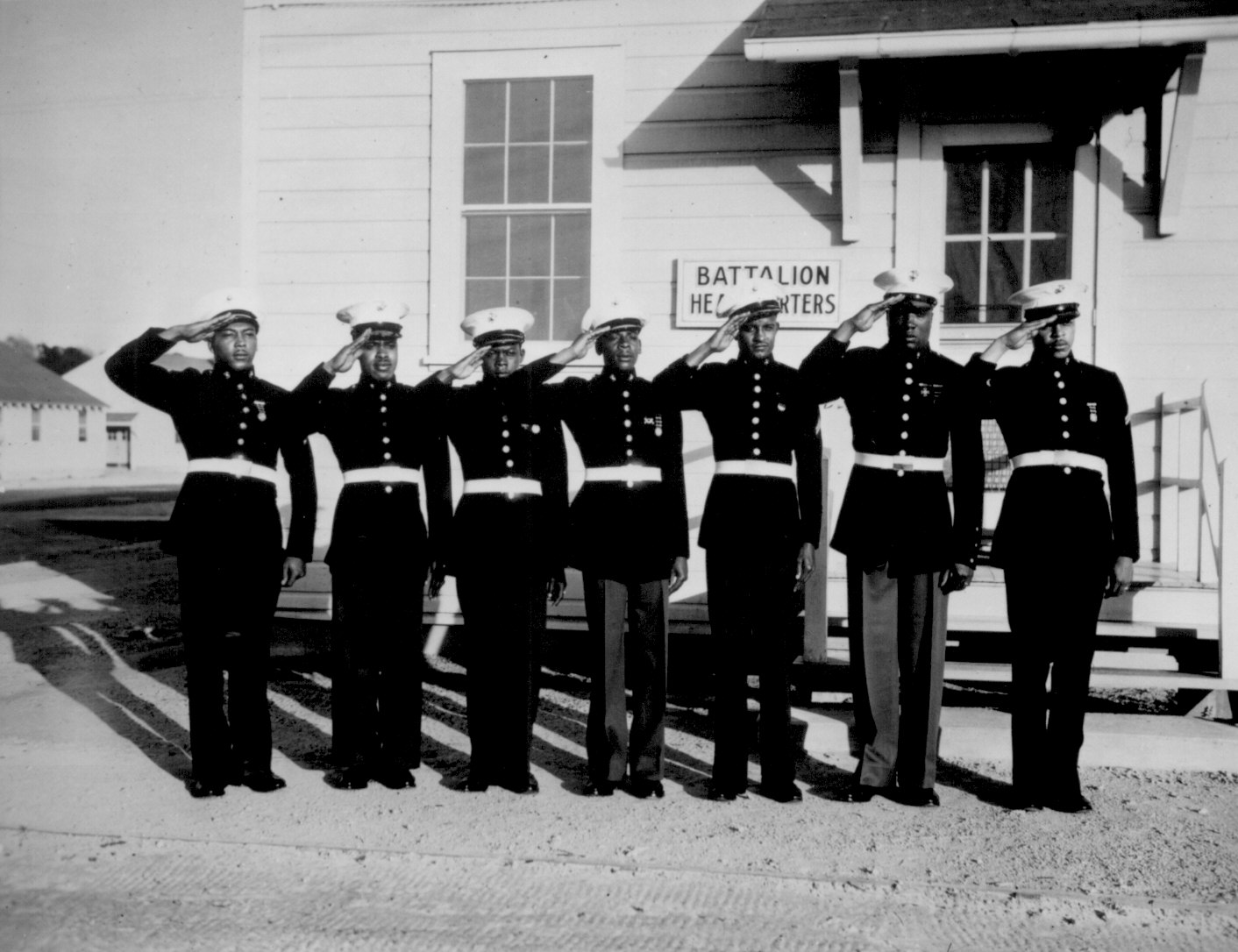
He did so brilliantly. He is especially notable for having photographed the country’s first black Marines.

"... Although a dress uniform is not a part of the regular equipment, most of the Negro Marines spend $54 out of their pay for what is generally considered the snappiest uniform in the armed services... Photo shows a group of the Negro volunteers in their dress uniforms." Ca. May 1943. Roger Smith. (Library of Congress Prints and Photographs Division)

“… Although a dress uniform is not a part of the regular equipment, most of the Negro Marines spend $54 out of their pay for what is generally considered the snappiest uniform in the armed services… Photo shows a group of the Negro volunteers in their dress uniforms.” Ca. May 1943. Roger Smith. (Library of Congress Prints and Photographs Division)

These men are not smiling, but surely that was because this formal photograph was intended to show their seriousness of purpose. It might also have been because their battles still lay ahead. The Marines were the last branch of the United States military to allow African Americans to enlist, and until 1949, they were housed at a segregated camp called Montford Point. In 2012, the surviving members of the group (known informally as the Montford Point Marines) were awarded the Congressional Gold Medal, the country’s highest civilian honor, in recognition of the discrimination they had faced—including having been excluded from combat roles. However overdue, Frederick Douglass might have smiled. At the start of Lincoln, the black soldiers who we see fighting in the film’s only combat sequence took part in the Civil War thanks in large measure to Douglass’s relentless advocacy to the Lincoln administration. This didn’t make it into the film, but it happened.

And so Willie Smith, who played the smallest of parts in the largest of wars, smiles, too. He knows what his photograph means.

(Postscript: The ship Smith helped to build, the SS Frederick Douglass, was a freighter. Perhaps this is unsurprising given that African American soldiers were generally assigned to support roles rather than combat during World Wars I and II. The ship and its mixed race crew was under the command of Captain Adrian Richardson, only the second black man appointed to such a position during the war. A German U-boat sank the Douglass on September 20, 1943 as part of a larger assault on the New York bound convoy of U.S. warships. A British ship rescued the Douglass’s entire crew, plus “one female stowaway.” This is also a true story.)

By the Decade: Russians in Mom Jeans

Vintage Ad #1,246: Class Fashions at Oakland Mall

Vintage Ad #1,246: Class Fashions at Oakland Mall (Photo credit: jbcurio)

The new show The Americans on F/X features a perfectly typical (ok—TV typical, meaning white and affluent) family living in the DC ‘burbs just shortly after Ronald Reagan became president. The catch is that, really, they’re super undercover Russian spies. So super undercover that they never ever speak Russian and even in flashbacks to their spy-in-training days they merely have heavy accents. Their kids aren’t in on it and so they innocently pipe up with the occasional mindless anti-Soviet remark. Meanwhile their mom, Elizabeth (Keri Russell), bustles about the kitchen but is really wondering whether she should go cut the throat of the Russian defector tied up in the trunk of the family Oldsmobile.

There are two ways to explain the appeal of the show’s premise. One is to put it down to Cold War nostalgia. The other is to chalk it up to 1980s nostalgia. Of course, since they happened at the same time, the answer can also be both. If the political issues were serious, the rest of the 1980s now seem quaint and laughable: look at those glasses! that hair! Isn’t that Roxy Music? Really, though, it’s the mom jeans. The show’s drama is supposed to be dark and serious, its moral quandaries, quagmires. But when the suburban mom / Russian double agent is wearing mom jeans, we’re in Red Dawn territory. No, not the remake, the original with Patrick Swayze (rest in peace), C. Thomas Howell, Jennifer Grey and even Charlie Sheen. The movie’s Cold War conceit—that high school students would lead the resistance after a Soviet invasion of the heartland—was pretty late in the game to be convincing. By 1984, the dark threat of nuclear annihilation still loomed, but fears of a full scale invasion were so 1950s. Thus Red Dawn—the dawn of the Soviet occupation that is—was more of a red herring. The movie’s most dramatic moment comes when C. Thomas Howell executes one of their own when he’s found to be hiding a Soviet tracking device. The Cold War setting just happens to be contemporary but its values have more in common with the 1980 WWII film, The Big Red One. And so it is with The Americans. It’s not about the Cold War, it’s about characters who aren’t sure who they can trust. Its 1980s setting seems like comic relief.

The mom jeans, in other words, beg to be laughed at. Just in case you didn’t know this, what we now call “mom jeans” are direct descendants of the above-the-bellybutton style of the ‘80s. Some people debate whether the high waist alone is enough to define a pair of pants as mom jeans, but it’s nearly impossible to look at people wearing jeans from the early ‘80s and not think it. To test this theory, you might try watching one of the live versions of Journey’s Don’t Stop Believing. As they perform the power ballad of the decade, the band members are decked out in muscle shirts, mullets, and, c’mon say it, mom jeans. Even so, surely one of the reasons the song has remained a hit for all these years, is its total sincerity. Its chorus, and Steve Perry’s performance of it, don’t hide a trace of irony. The band still tours on the strength of this song, even now that Perry refuses to have anything to do with them. (Amazingly, the remaining members managed to outsource the job to a singer from a cover band in the Philippines who they discovered via a youtube video. Really.)

The nostalgia of looking at and laughing at early ‘80s style in a 2013 show would seem to have a lot to do with the reputed sincerity deficit of our own times. No doubt it also has a lot to do with the fact that people who were teenagers in the 1980s are now forty-somethings, and suffering the first pangs of mid-life crises. It’s somehow less ridiculous to look back longingly for one’s lost youth if one first engages in ritualistic mockery of it. And sad to say, middle aged women bear the brunt of it (mom jeans, after all, feminizes something that was unisex back in the day). How else to explain the popularity of recent episodes of What Not to Wear that featured makeovers of Mindy Cohn (Facts of Life) and Tina Yothers (Family Ties), adolescent stars of 1980s hit shows? Both decided to hide their aging, and now less than famous selves, behind ill-fitting clothes until Stacy and Clinton swoop in to save them. The show’s usual early doses of humiliation are made collective by virtue of the fact that they were practically family for those old enough to have watched TV in the 1980s. The women’s ultimate redemption—now clothed in of the moment style—is that much more satisfying for the suffering. We can laugh at the 1980s and love them, too. The Russians in The Americans are about as threatening as they were back in that Wendy’s commercial. But Boy George, who was hard to take seriously back in 1983, now seems so sweet, so sincere, and so right when he points out that the past is never truly gone.

Karma karma karma karma karma chameleon,

You come and go, you come and go-oh-oh-oh . . .

Sing it, everyone.